


Compass pendant and chain: which link carries it best?
You search for a compass necklace, you see a photo of a pendant on a chain, and you assume that is one product. It is not. We carry two compass pendants, in gold tone and in silver tone, and you choose the chain underneath yourself.
That is not a detail for the checkout page, that is the whole decision. A pendant hangs from one point and pulls there. The link you hang it on decides whether it keeps facing forward or twists sideways all day. This guide is about that combination: link, width and length.

1. A pendant and a chain are two purchases
The gold-tone compass pendant and the silver-tone compass pendant both ship as a pendant on its own: you buy the chain separately. The jewelry box holds the pendant, and nothing else.
Both are stainless steel with five layers of PVD, where the color is bonded to the metal in a vacuum chamber. Same build as our other pendants, such as the silver cross pendant at 2.9 by 1.8 cm and the dog tag pendant at 18 by 30 mm. A compass in solid 925 silver or solid gold does not exist here: the gold tone is PVD over steel, not the metal itself.
Buying them apart costs you a second decision, but you do get to pick the chain that suits your neck and your day, and you can replace it later without losing the pendant.

2. Why a round link carries a pendant better
A chain without a pendant spreads its weight over its whole length. Add a pendant and nearly all of it lands on one point: where the bail sits over the link.
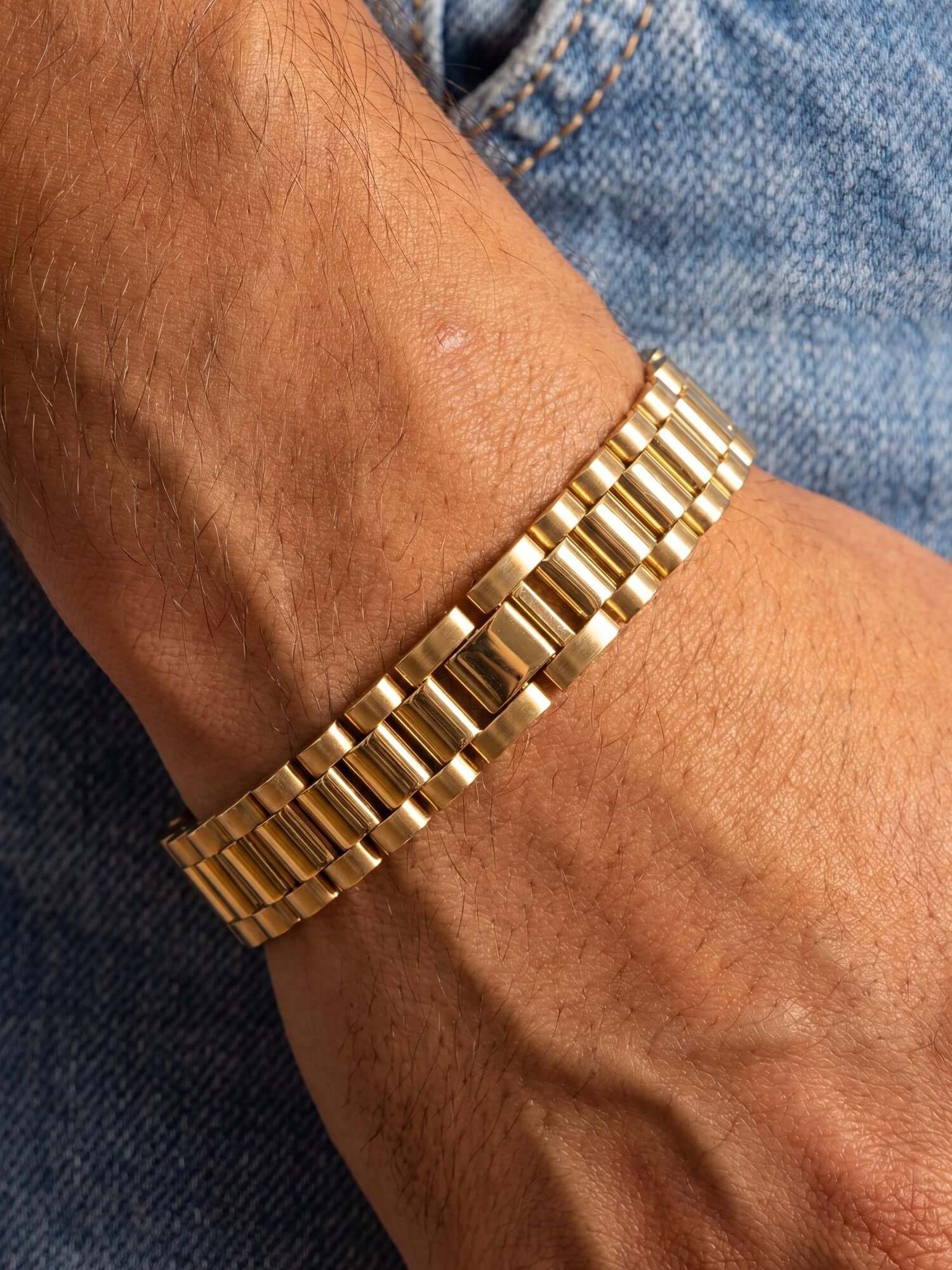
What happens next depends on the cross section. A flat link, such as a Cuban, has a wide side and a narrow side. Under the pull it takes the path of least resistance: the strand rotates on its long axis and the pendant turns with it. You then see it hanging half on its edge.
A round strand does not have that flat side. In cross section it is the same width all the way around, so there is no position it would rather settle into. With a round design like a compass that counts double, because a circle has no top edge to hide the tilt.
3. The three links that can do it
The box chain is the crispest: square links that sit so tightly together that the strand behaves as one piece. We carry it in silver tone and gold tone, in 2 mm and 3 mm, in 45 cm (18 in), 50 cm (20 in) and 55 cm (22 in). How those lengths land is covered in our guide to box chain length.
The rope chain is twisted and catches light along the whole strand. The silver-tone rope in stainless steel comes in 2 mm and 3 mm and in 45, 50, 55 and 60 cm (18 to 24 in). There is also a rope in solid 925 sterling silver at 2 mm, in 50, 55 and 60 cm (20 to 24 in).
The Franco, also called foxtail, is the densest: a woven 3 mm strand in 50 and 60 cm (20 and 24 in) that barely loses its shape. Under a heavier pendant this is the calmest choice, because there is no gap in the link for the bail to sink into.
And Cuban? It was made for something else: a Cuban is the jewelry itself. Hang a pendant on it and two things compete for the same spot, while the flat link tips over underneath as well.

4. Width: the floor and the ceiling
With a pendant, width has two limits, and they sit close together. The floor is around 2 mm. Below that the chain becomes the weak point: the weight lands on the bail and the two links beside it, and if the strand is too fine there it stretches or snaps right there. The pendant does not break, the chain does.
The ceiling is around 3 mm. Above that the chain starts competing. A 5 mm strand already has plenty of presence, and then the pendant becomes a detail on a chain instead of the other way around.
In between you choose on use. On a compass, 2 mm reads light and fine and 3 mm reads sturdier. If you wear it daily, 3 mm is the safer pick, because the pull spreads over more material there.
5. Length: count where the pendant lands
The size on the chain says where the strand ends up, not where the pendant ends up. The pendant hangs below that. Small in centimeters, large in how it sits.
Roughly: 45 cm (18 in) sits against the neck, 50 cm (20 in) falls high and stays inside a buttoned shirt, 55 cm (22 in) lands just below the collarbone and is the most chosen size, and 60 cm (24 in) hangs free on the chest.
With a pendant that whole range shifts down. If you want the pendant just below your collarbone, choose the length that would land just above it without one. Not sure? Use the chain size chart.
Wearing a second chain alongside it? Keep about 10 cm (4 in) between them, otherwise they slide over each other and the pendant disappears behind the other strand.

6. Material: steel with PVD or solid silver
Stainless steel with five layers of PVD is the practical route. The silver-tone box and the silver-tone rope do not have to come off for washing your hands, rain or the shower. The gold-tone box is different: it comes off before the pool, the shower and the gym, and goes on once perfume or aftershave has dried.
Solid 925 sterling silver is the other route. The rope in 925 silver is 92.5 percent pure silver with copper for strength, and there is no layer around it to wear through: what you see is the metal itself. In return, silver is softer than PVD, so fine marks show up sooner and the strand can darken over time.
A steel pendant on a silver chain is technically fine. At most you see a difference in tone. If you want one whole, keep the same finish. Why so many people land on box for this pairing is covered in five reasons for a silver box chain.

7. Care: the pendant asks more than the chain
A pendant sits in the same spot against your skin all day, so it collects more sweat, deodorant and aftershave than the chain around it. The strand moves and dries, the pendant does not.
So: perfume first, let it dry, then put it on. Once a week, take the back of the pendant along with a soft cloth. Lukewarm water with a drop of mild soap is enough, then dry it well.
Store the pendant and the chain apart. Left together, the bail keeps rubbing over the same two links, exactly where the load already sits. If 925 silver darkens, bring it back with a silver cloth. No ultrasonic bath, no abrasives.
Four mistakes you spot right away
- Hanging a pendant on a flat link. The strand tips over under the pull and the pendant ends up half on its edge. Choose box, rope or Franco.
- Going below 2 mm because it looks finer. The chain then becomes the weak point, and it gives way beside the bail of the pendant.
- Choosing the length as if no pendant were on it. The pendant lands lower than the strand itself, so you end up one size too low.
- Storing pendant and chain in the same compartment. The bail then rubs over the same two links, exactly where the load already sits.
Where do you start?
Keeping it simple? The silver-tone compass pendant with the silver-tone box chain at 3 mm on 55 cm (22 in). Round in cross section, crisp in line, and fine in rain and the shower.
Looking for gold tone? Take the gold-tone compass pendant with the gold-tone box chain in the same width, and keep to the rule that it comes off before the pool and the gym.
More shine in the strand itself? The rope in stainless steel is the step sideways. Precious metal under your pendant? Then the rope in 925 silver at 2 mm, and for the calmest carrier the Franco at 3 mm. Browse further in the pendants collection, the box collection and the rope collection.
Frequently asked questions
Does the compass pendant come with a chain?
No. The gold-tone compass pendant and the silver-tone compass pendant ship as a pendant on its own, in a Carpe Ice jewelry box. You buy the chain separately.
Which link carries a compass pendant best?
A round strand: box, rope or Franco. It has no flat side to twist onto, so the pendant keeps facing forward. A flat link such as a Cuban tips over under the pull.
Which chain width suits a compass pendant?
Between 2 and 3 mm. Below 2 mm the chain becomes the weak point beside the bail, above 3 mm the strand starts competing with the pendant. If you wear it daily, 3 mm is safer.
Is there a compass necklace in 925 silver or solid gold?
No. We carry two compass pendants, both stainless steel with five layers of PVD. Solid 925 sterling silver you will find in the chain, for example in the rope at 2 mm.
Which length do I choose when a pendant hangs on it?
Count where the pendant lands, not where the strand lands. 50 cm (20 in) falls high, 55 cm (22 in) lands just below the collarbone and 60 cm (24 in) hangs free on the chest. With a pendant that shifts down.
Can the compass pendant go in the shower?
The silver-tone pendant does not have to come off for washing your hands or a rain shower. With a gold-tone finish, keep to taking it off before the pool, the shower and the gym.