
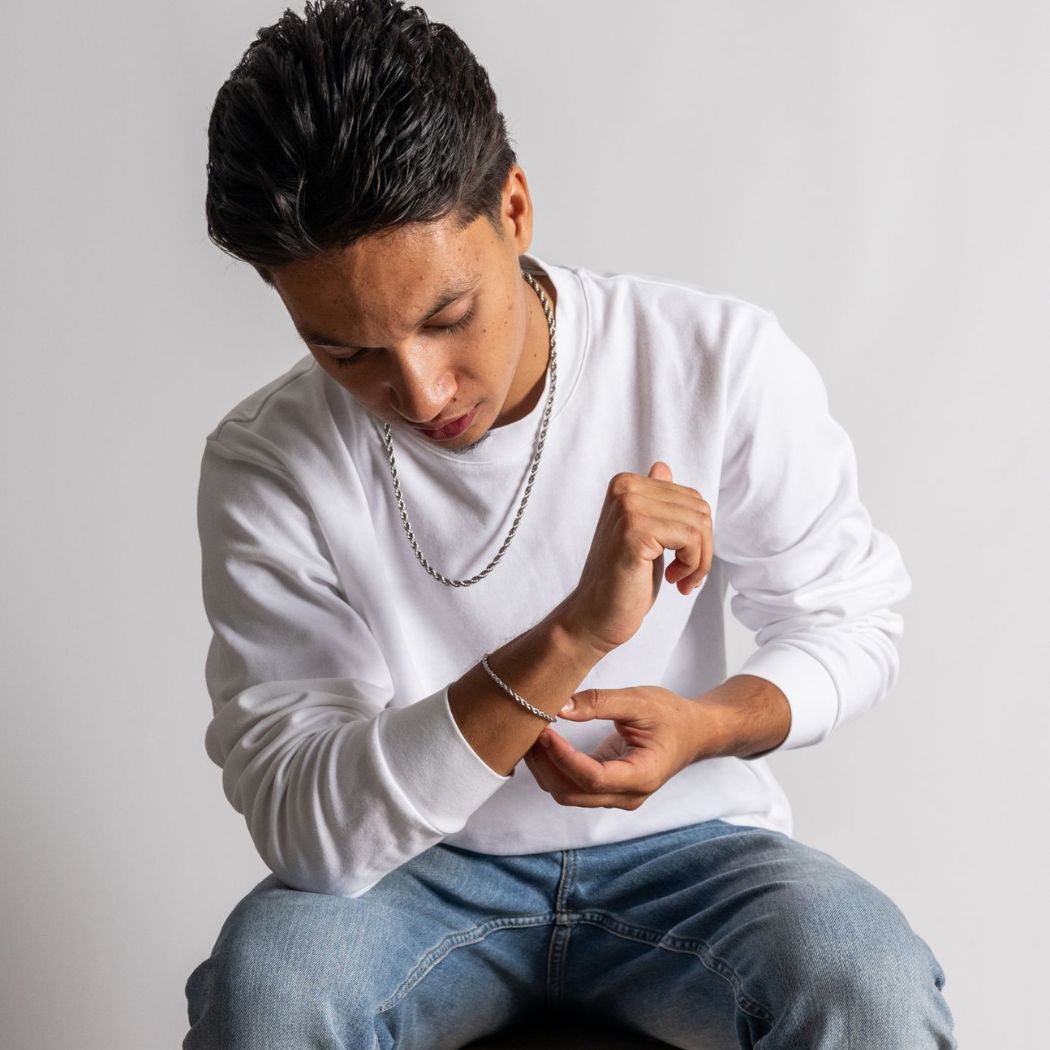
Jubilee bracelet: the five piece link with a folding clasp
Two things decide how this bracelet looks, and most texts about it never mention either one: the link counts five pieces per row, and it closes with a folding clasp instead of a lobster hook. Those two choices explain both the bright band running down the center and the fact that the bracelet stays the same thickness all the way around.
The link is called a Jubilee link. Many people search for it under the name of the watch brand that made the pattern famous. Here the name describes the link type and nothing else: this bracelet is not made, not sold and not endorsed by any watch brand, has no connection to one whatsoever, and we sell it as the Carpe Ice Jubilee bracelet. What you buy is a bracelet in stainless steel, 10 mm wide (0.4in), no stones, with a folding clasp, in 18, 20 or 22 cm (7.1in, 7.9in or 8.7in).

The five piece build and what it does to light
Lay five small bars side by side and you have one row of this bracelet. The outer two sit flat and form the edge. The three in the middle sit higher and together form a raised band that runs the full length. At a width of 10 mm each piece is roughly 2 mm, so six of those ten millimeters sit in the raised center band and four millimeters make up the two flat edges.
That difference in height is the whole effect. Light falling on the center band bounces almost straight back to your eye, while the lower edges send it off at an angle. You see a bright stripe down the middle and duller edges, even when the bracelet is lying still on a table. Turn your wrist five degrees and the stripe shifts one row across. That is why this link seems to move when nothing is moving.
It is also why the silver colored version looks different from a flat link of the same width. A flat 10 mm bracelet either lights up all at once or is dull all at once. Here every row has three heights at the same time, so some part is always catching light. Under indoor lighting that leaves you with more sparkle.
The folding clasp against a lobster clasp
A lobster clasp is a separate part hanging between the two ends. On a fine chain you hardly notice it, but on a 10 mm bracelet that is exactly the spot where the whole thing gets thicker. Heavier clasps also rotate to the underside of the wrist, because they follow gravity.
A folding clasp works differently. Two hinged plates fold into each other underneath the link and then sit in line with the bracelet, at the same height as the rest. Your bracelet keeps the same thickness all the way around and the clasp cannot roll upward, because there is no loose part to turn.
Three practical consequences. You close it one handed, which stays awkward with a lobster hook on your own wrist. It clicks audibly, so you know it is shut without looking. And it does not spring open when your sleeve catches on something. Most other bracelets in our collection close with a lobster clasp, so this is the distinguishing feature of this model.

One width: why 10 mm is right for this link
We carry this link in exactly one width: 10 mm. That is not a coincidence and not a sourcing limit, it follows from the build. Divide 10 mm by five pieces and you get roughly 2 mm each, just enough to make the height difference between center and edge visible.
At 6 mm each piece drops to 1.2 mm. The height difference left over is so small that the center band no longer shows as a separate band and you simply see a striped bracelet. Above 12 mm the opposite happens: the rows get so wide that the bracelet no longer follows the top of your wrist bone smoothly.
10 mm also sits in the range where a bracelet can share a wrist with a watch without competing with it. A watch case is usually 38 to 44 mm, so 10 mm takes up about a quarter of that. Our guide to the most popular bracelets for men lines up the rest of that width class.
Three colors and what five layers of PVD means
The link comes in three colors: gold tone, silver tone and rose gold tone. All three share the same core, stainless steel. The silver tone is the bare polished steel itself; the gold tone and rose gold tone carry a finish of five layers of PVD. There are no stones in it and there is no version with zirconia or moissanite.
PVD stands for physical vapor deposition. In a vacuum chamber the color layer settles onto the steel as a vapor and bonds to the metal at molecular level, instead of being applied by electroplating. Five of those layers on top of each other are considerably harder than an ordinary plated layer, and the core underneath stays stainless steel. Every gold-tone and rose-gold-tone piece in our stainless steel jewelry range is built this way.
For the color, one simple rule helps: look at what is already on that wrist. A steel watch calls for silver tone, a gold or two tone watch for gold tone. Rose gold tone is the warmest and the quietest of the three, so it is the choice when you want the pattern but not the shine of yellow gold.

Size: 18, 20 or 22 cm (7.1, 7.9 or 8.7in), which is wrist plus 1.5 cm
The bracelet comes in 18, 20 and 22 cm (7.1in, 7.9in and 8.7in). Measure your wrist with a tape measure or with a strip of paper held against a ruler, and add about 1.5 cm. At a wrist of 16.5 cm (6.5in) you take 18 cm (7.1in), at 18.5 cm (7.3in) you take 20 cm (7.9in) and at 20.5 cm (8.1in) you take 22 cm (8.7in). If you land exactly in between, take the smaller size: a wide link is more annoying too loose than too snug.
A good fit here means the bracelet can slide about 1 to 1.5 cm along your wrist and stops against the wrist bone. If it can roll over the base of your hand it is too loose, and the folding clasp will sink to the underside anyway, which is the thing that clasp is there to prevent.
Unlike a lobster clasp there is no extension chain to adjust. The size you pick is the size you wear, so measuring saves you a return. The bracelet size chart lists which size goes with which wrist measurement.

Care: where the shine goes first
PVD on steel is hard, but it stays a finish and not solid metal. Wear therefore starts where contact is heaviest: the two hinge points of the folding clasp, the underside that rests against a desk or a steering wheel, and the edges of the outer pieces. The raised center band is the last part to go.
Cleaning is simple: lukewarm water, a drop of mild soap, a soft toothbrush between the rows and then dry it properly with a soft cloth. Five pieces per row means more seams than a smooth link has, and soap collects in them.
Water advice differs per color. The silver tone one can stay on in the shower and during a workout. The gold tone and rose gold tone ones are better taken off before the pool, the shower and the gym, and put back on once perfume and hand cream have dried. Chlorinated water is the harshest on all three.

Four mistakes you spot straight away
- Buying it too loose. If the bracelet can roll over the base of your hand, the folding clasp still ends up on the underside of your wrist and you spend the day looking at the clasp.
- Wearing it right against your watch. Metal against metal on the same wrist scratches both. Move the bracelet to the other wrist, or keep at least a finger of space between them.
- Taking it into the pool. Chlorine is harsher on a PVD finish than salt water or sweat, and the clasp is the first place you see it.
- Assuming you can adjust the size later. A folding clasp has no extension. It is 18, 20 or 22 cm (7.1, 7.9 or 8.7in), so measure your wrist before you order.
Where do you start?
If you are torn between the colors, start with your watch. A steel case pairs with the Jubilee bracelet in silver tone, a gold or two tone watch with the gold tone version. If you do not wear a watch, silver tone is the safest first buy, because it sits well next to almost any other piece.
Looking for something warmer or something that draws less attention? Then the rose gold tone Jubilee bracelet is the third option, in the same sizes and the same build.
To look further: jewelry for him and jewelry for her show per style what pairs with this link.
Frequently asked questions
What is a Jubilee link made of?
Five pieces per row. The outer two sit flat and form the edge, the three in the middle sit higher and form a continuous raised band. At 10 mm wide each piece is roughly 2 mm.
What is the difference between a folding clasp and a lobster clasp?
A folding clasp folds into two hinges underneath the link and sits in line with the bracelet, so the bracelet keeps the same thickness all the way around. A lobster clasp is a separate part that builds thicker and rotates to the underside of your wrist.
Which size Jubilee bracelet do I need?
Measure your wrist and add about 1.5 cm. At 16.5 cm (6.5in) you need 18 cm (7.1in), at 18.5 cm (7.3in) 20 cm (7.9in) and at 20.5 cm (8.1in) 22 cm (8.7in). This model has no other sizes.
What material is the Jubilee bracelet made of?
Stainless steel, in silver tone (bare polished steel) or in gold tone and rose gold tone (five layers of PVD). There are no stones in it and there is no solid gold or 925 silver version.
Can the Jubilee bracelet handle water?
The silver tone one can stay on in the shower and during a workout. The gold tone and rose gold tone ones are better taken off before the pool, the shower and the gym. Avoid chlorinated water with all three colors.
Is the Jubilee bracelet for men or for women?
For both. The width is 10 mm and the sizes are 18, 20 and 22 cm (7.1, 7.9 and 8.7in), where 18 cm (7.1in) suits a narrower wrist and 22 cm (8.7in) a wider one. The link itself is neutral.