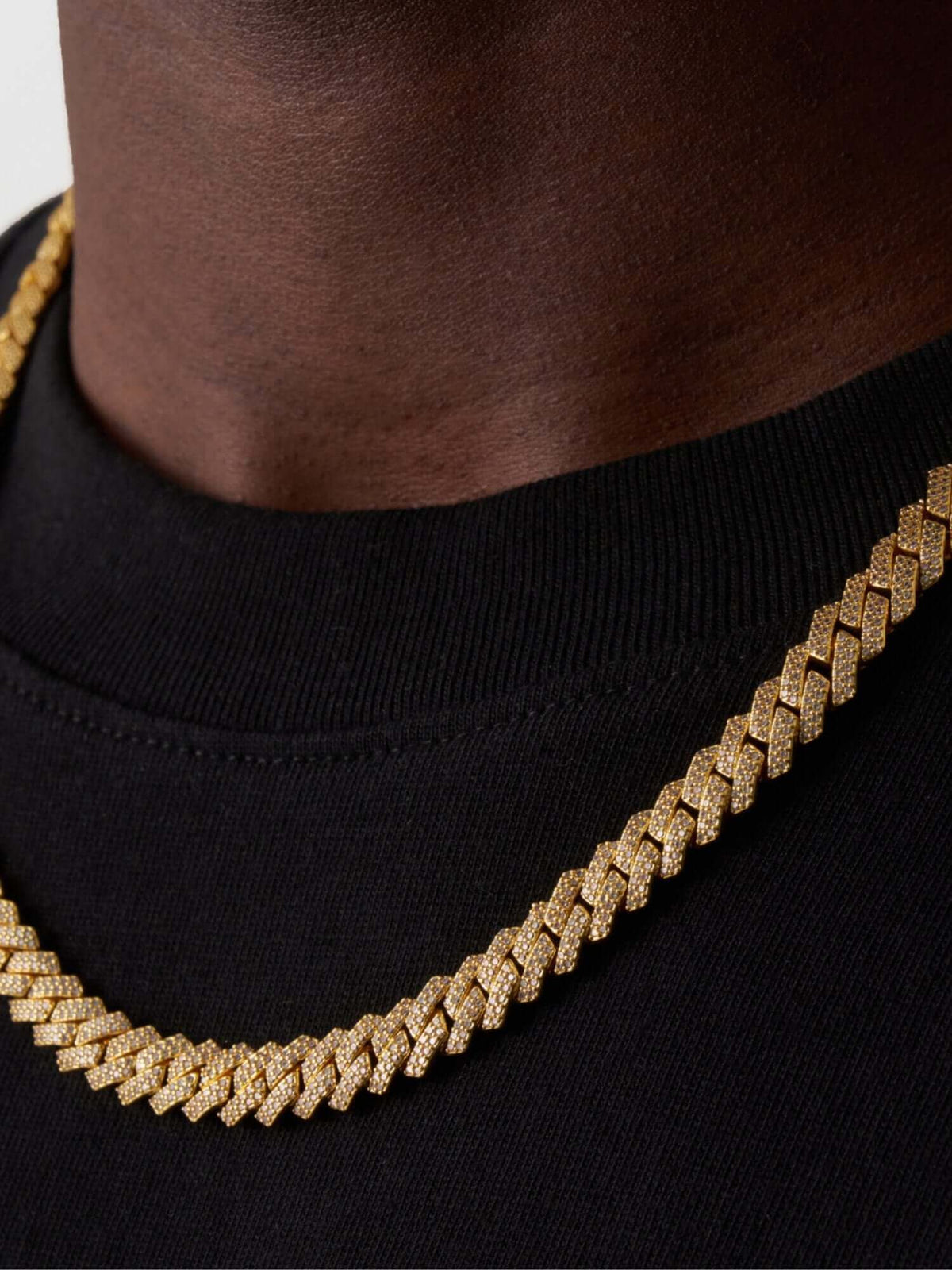

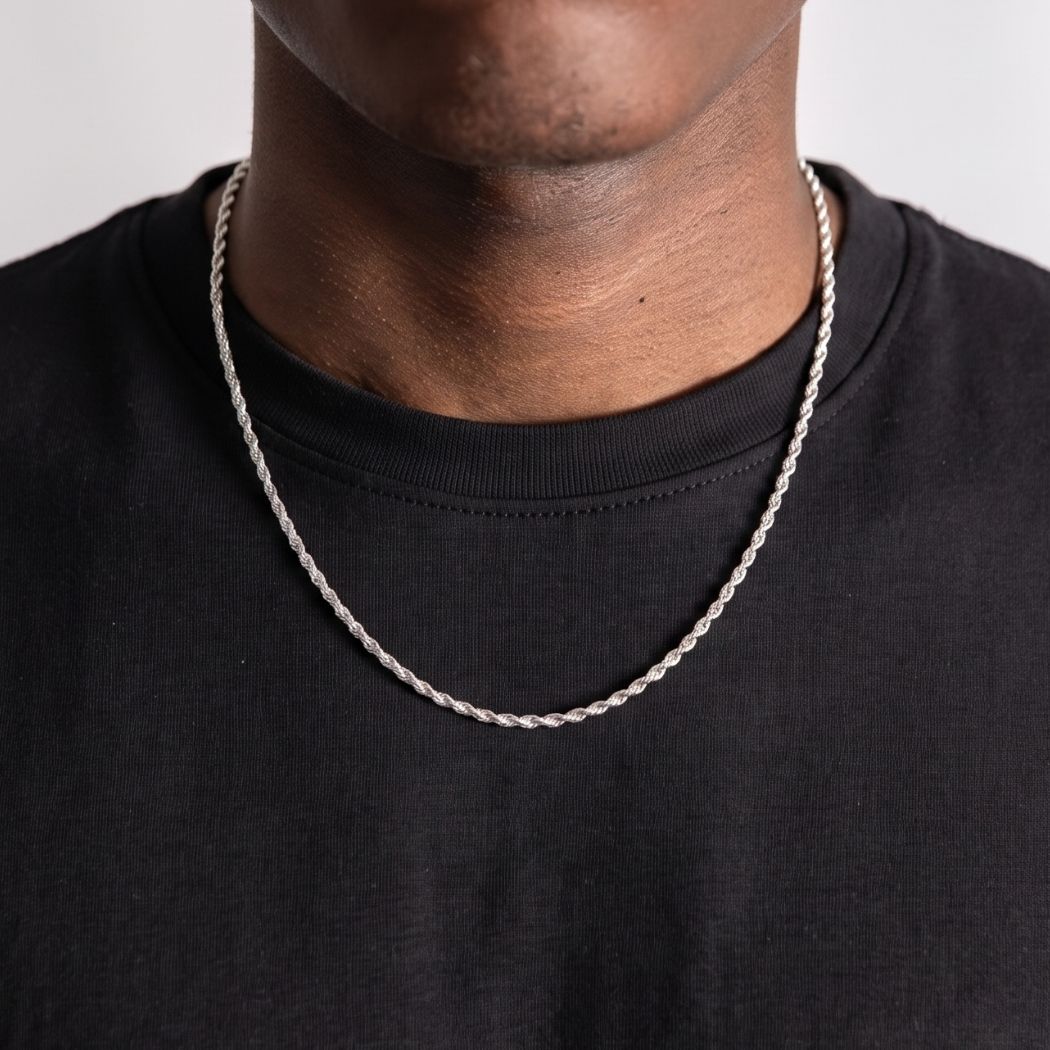
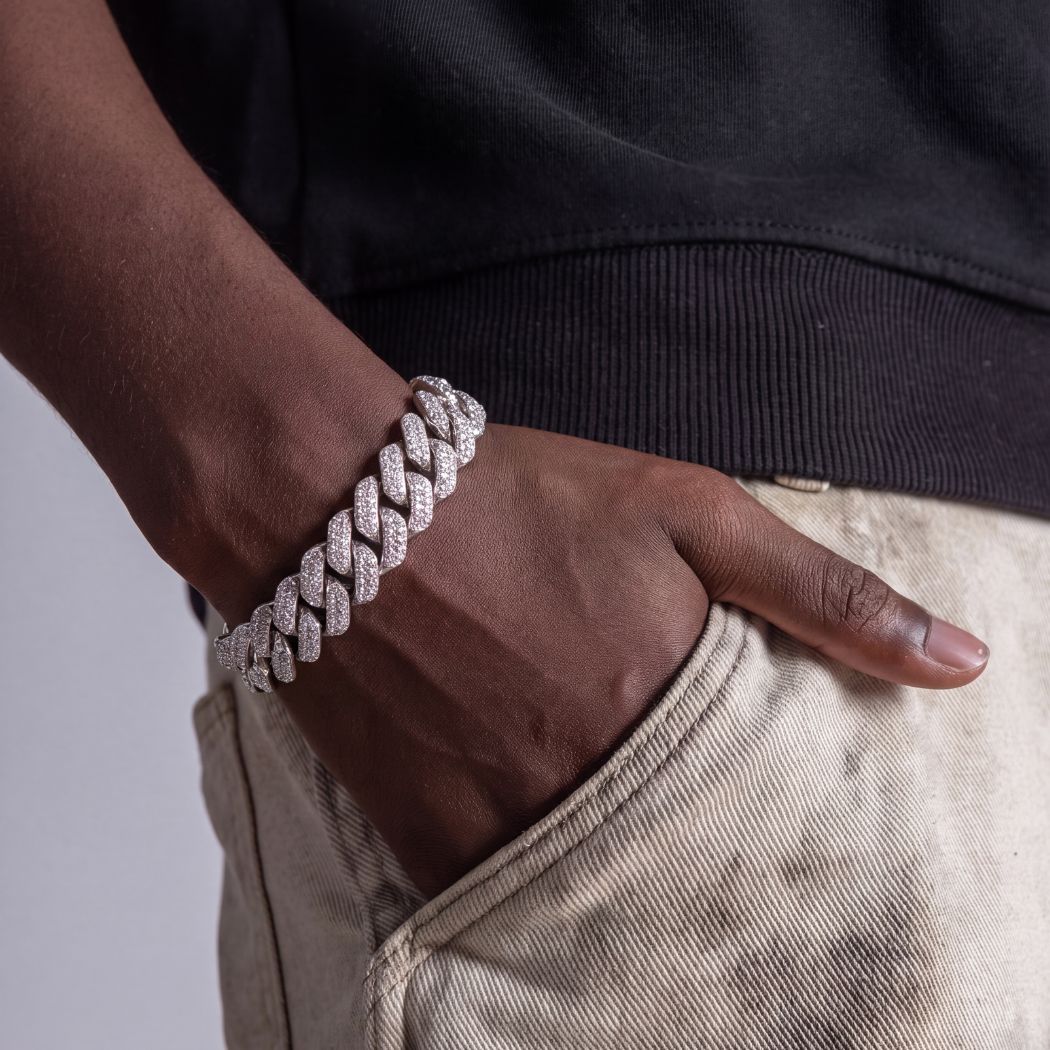
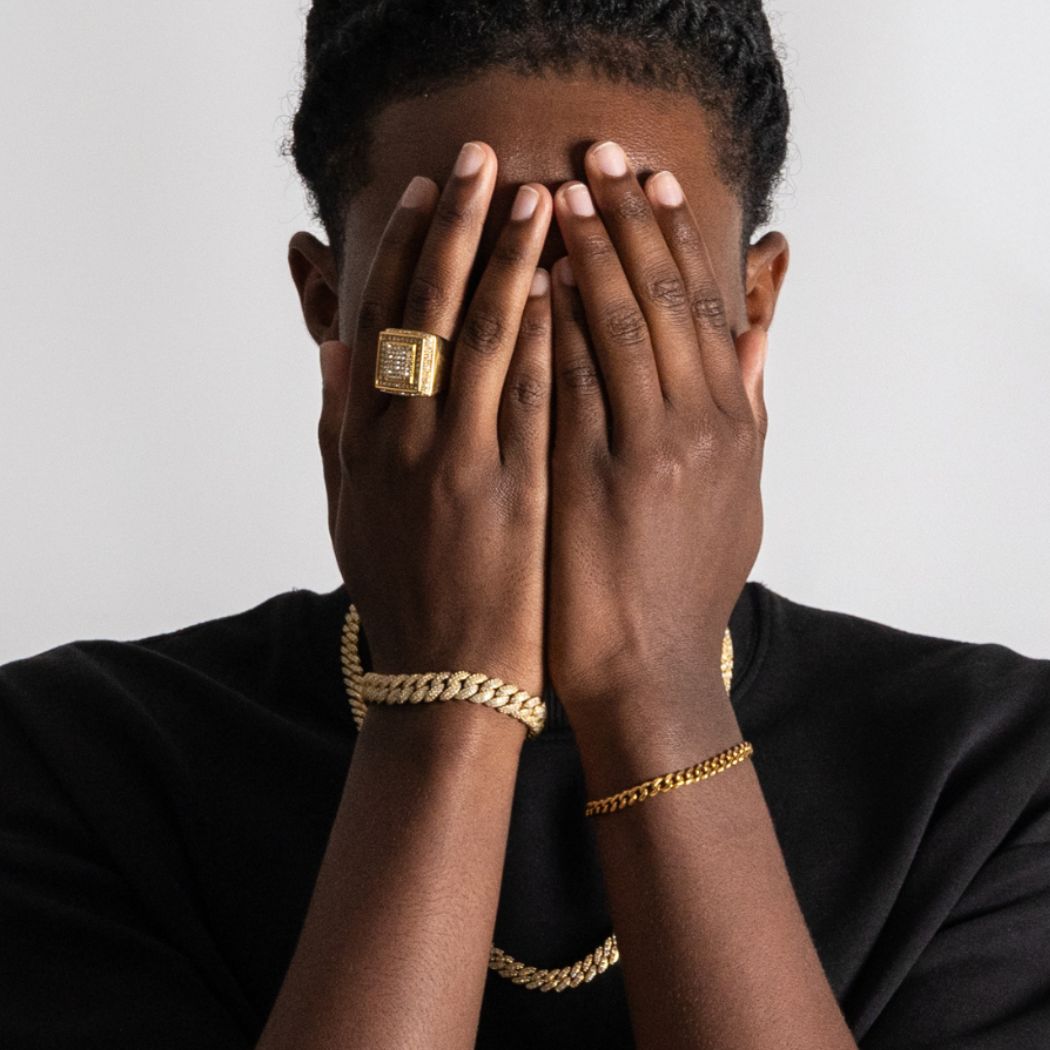

Box chain as a base for a pendant: 2 mm or 3 mm
You hang a pendant you love on the chain you already had, and half an hour later it is sitting sideways. That is almost never the pendant. That is the link underneath it.
The box is the most underrated link in our box chain collection, and the reason is functional: it is the tightest strand we carry, equally thick from every side and without a flat face that can flip over. That is why it carries a pendant better than anything else in our range. This guide is about that function, about the two widths, and about which pendant belongs on which width.

1. What a pendant does to a link
A pendant does not hang still. It pulls on one point and looks for the path of least resistance. Which path that is comes down to the cross section of the link underneath.
A flat link, like a cuban or a figaro, is wide in one direction and thin in the other. Under weight that kind of link picks the thin side, because turning costs the least energy there. The strand rolls a quarter turn and takes your pendant sideways with it. You push it back, and ten minutes later it is crooked again.
A box link is built from closed blocks with four equal faces. There is no thin direction, so there is no direction the strand would rather fall in: the pendant keeps pointing forward. On top of that, a closed block is stronger than an open link of the same thickness, because the bearing point at the bail is a closed ring instead of a bent wire.
2. What this chain actually is
One thing has to be clear, because this is where the category often goes wrong. The Carpe Ice box chain is stainless steel, in a silver color or a gold color. The silver-colored version is bare polished steel, so it is silver-colored, not silver. There is no 925 in it and it should carry no silver hallmark.
The gold color comes from PVD, physical vapor deposition: the color is bonded to the steel on a molecular level in a vacuum chamber instead of being electroplated, and here that happens five times. Harder and more scratch resistant than an ordinary plated layer, but it stays a finish on steel.
Two consequences work in your favor. Stainless steel does not tarnish, so no black film between the blocks and no polishing cloth. And steel is less sensitive to moisture than the nickel-free copper alloy under our iced out pieces, so the silver-colored box can come along into the shower. More on the same base in the stainless steel collection.
The gold-colored version is the same steel with five layers of PVD in a gold color. That one you do take off before the pool, the shower and the gym.
3. 2 mm or 3 mm: where the limit sits
The box runs in two widths, and that is not an arbitrary choice. Below 2 mm the strand gets too fine for daily weight. Above 3 mm it turns stiff: the blocks get so large that the chain drapes less easily.
The 2 mm is the classic pendant carrier. It barely draws attention on its own, disappears under a buttoned shirt and lets the pendant set the picture.
The 3 mm is the point where the chain joins in. It is visible without a pendant, carries heavier pieces without pulling the line crooked, and spreads the load better across the lobster clasp.
The rule: if your pendant is heavier than a thin plate or larger than about 3 cm, take the 3 mm.

4. The lengths, briefly: 45, 50 and 55 cm (18, 20 and 22in)
The box chain comes in 45 cm (18in), 50 cm (20in) and 55 cm (22in). 45 cm (18in) sits snug at the base of your neck, 50 cm (20in) falls just below the collarbone and works on most necks, 55 cm (22in) falls on the top of your breastbone.
If you wear a pendant on it, pick shorter than your instinct says. Extra chain length divides over two sides and therefore counts only half, while the pendant adds its full height at the bottom. That is why 50 cm (20in) lands right more often than 55 cm (22in).
Looking for 60 cm (24in)? That is where this link stops. We do not carry the box longer than 55 cm (22in), because a fine strand goes slack at that length and ends up hanging inside your clothes instead of on them. If you want longer, pick a wider link type.
The full calculation per length is in our separate guide which box chain length suits you best. For quick measuring, use the chain size chart.
5. Which pendant asks for which width
Four pendants, with the width that belongs to each. On all four, watch the bail: it differs per pendant, and a bail that is too tight for 3 mm forces you down to 2 mm, however heavy the piece is.
Compass. Round, flat and light. The gold compass pendant and its silver-colored twin both hang fine on 2 mm. A round piece shows the turning problem most clearly: a compass with the dial facing sideways is pointless straight away.
Cross. Our silver-colored cross pendant is 2.9 cm long and 1.8 cm wide: visible enough and light enough for 2 mm. But a cross is asymmetric, with more mass below than above, and that makes the tilting on a flat link worse.
Clover. The clover pendant is 2.1 by 3.8 cm and is solid 925 sterling silver with VVS cubic zirconia. The heaviest of the four, and the only one with real silver in it. Here you take 3 mm: a wide face with stones needs a tight strand to keep lying flat.
Dog tag. An engravable plate of 18 by 30 mm. Flat and light, so 2 mm works, but this is the kind of pendant you wear every day and therefore want on the strongest strand. 3 mm is the safe choice.

6. Wearing the box without a pendant
A box does not have to be a carrier. Without a pendant it comes down to how the blocks catch light. Every face is a small mirror sitting at a slightly different angle than its neighbor, so you get no continuous shine but a row of separate points of light that travels along as you move.
For wearing it bare, 3 mm is the logical choice. On 2 mm a plain box stays a fine line that disappears at a distance.
Want to carry the shape through to your hand? Then there is the silver-colored box ring with VVS cubic zirconia: the same block logic with hand-set stones, in sizes 7 through 11.

7. Care: it is in the seams
A box link has many seams per centimeter, and that is exactly where the things that dull the shine collect: skin oil, soap residue and dust. That is not wear of the finish.
Lukewarm water, a drop of mild soap and a soft toothbrush get it out. Dry well afterwards with a soft cloth, because water left between the blocks attracts fresh dust. A silver polishing cloth is not needed here.
Two rules for the long run. Put on perfume, aftershave and deodorant before you put the chain on and let it dry, because alcohol attacks the finish over time. And store the chain separately, because the edges of a wider link scrape across the faces of the box.
Check the bail of your pendant every few months. That is where you see first whether a piece is too heavy for the width you chose.

Four mistakes you spot right away
- A heavy pendant on 2 mm. The line pulls crooked and all the load lands on one point at the clasp. Above about 3 cm you move up to 3 mm.
- Hanging a pendant on a flat link. It rolls onto its thin side and takes your pendant with it. On a compass you see that within half an hour.
- Taking the gold-colored version into the shower. The silver-colored one may go, the gold-colored one comes off for swimming and the gym.
- Looking for 60 cm (24in) in this line. The box stops at 55 cm (22in). Anyone who wants longer needs a wider link.
Where do you start?
Buying the chain for a pendant? Take 50 cm (20in) and pick the width by the weight of that piece: 2 mm for a compass or a flat plate, 3 mm for a clover or anything above about 3 cm.
Wearing it bare? Then 3 mm in 50 cm (20in) or 55 cm (22in) is the version that stands on its own, in a silver color or a gold color.
If you do not know the pendant yet, browse the pendant collection first and pick the width afterwards. And if you want to see the links side by side, the full necklace collection is ready for you, from fine strands to the wider types you end up with at 60 cm (24in) and longer.
Frequently asked questions
Is the Carpe Ice box chain made of silver?
No. The box chain is stainless steel: bare polished steel in the silver color, with five layers of PVD in the gold color. So it is silver-colored and not silver, and there is no 925 in it. Of our pendants, the clover is solid 925 sterling silver.
Why does a box link carry a pendant better than a flat link?
A flat link is wide in one direction and thin in the other, and under weight it rolls onto that thin side. The box is built from closed blocks with four equal faces, so there is no direction the strand would rather fall in and the pendant keeps pointing forward.
Do I pick 2 mm or 3 mm for my pendant?
2 mm for a light, flat piece such as a compass or an engraving plate. 3 mm as soon as the pendant is heavier or larger than about 3 cm, and also if you want to be able to wear the chain bare.
Does the box chain come in 60 cm (24in)?
No. The box runs in 45 cm (18in), 50 cm (20in) and 55 cm (22in), in 2 mm and 3 mm. We do not carry this link any longer, because a fine strand goes slack at that length. If you want 60 cm (24in), pick a wider link type.
Does every pendant fit a 2 mm box chain?
Not automatically. The bail differs per pendant, and a tight bail sets the maximum strand that runs through it. If the bail is roomy, weight decides: above about 3 cm of pendant size you take 3 mm.
Can the box chain come into the shower?
The silver-colored version can, because it is bare stainless steel with no coating and it does not tarnish. The gold-colored one comes off before the shower and the gym. Both come off for the pool. Rinse them with tap water after sea water and dry them well.