



What determines the price of a king's link chain?
How much a king's link chain costs has no answer that will still be right in six months. Where that price comes from does, because it is in the jewelry itself and not in a table.
Four things decide it together: the construction, the width, the length, and whether the link is solid or hollow. Know those four and you can judge for yourself whether any price makes sense. This guide walks through them using the king's link chains we carry.

1. Why there is no single price
Under the name king's link chain we carry three constructions, three widths and lengths from 50 cm (20in) to 75 cm (30in). Between the finest and the heaviest version there is more difference in material than between two random chains.
Then there is the build. A king's link is a dense braid. On a flat link almost all the metal sits on the outside. On this link a good part of it sits inside the weave, where you do not see it but you do feel it. Two chains that look equally wide in a photo are often far apart.
If you want to know how that braid is put together, read how a king's link is made. If you want to know which types exist, start with the complete guide to types of king's link chains.
2. Construction: what the braid is made of
This is the biggest of the four factors and the only one you cannot see in a photo. We carry three constructions, and that is the whole list.
Stainless steel, bare or with five layers of PVD
The 5mm king's link chain in silver color and the gold-colored version are stainless steel. The silver-color version is bare polished steel. The gold color comes from five layers of PVD, bonded to the steel at molecular level in a vacuum chamber. Steel is cheap as a raw material, which is why this is the entry point. What you pay for sits in the braiding and the finish, barely in the metal.
Solid 925 sterling silver
The 2.5mm king's link chain in 925 sterling silver is a precious metal: 92.5% silver, alloyed with copper for strength. Here you pay for the metal itself, which is why a narrow silver chain lands higher than a wider one in steel. There is no layer around it that can wear through.

18K gold plated over a silver core
The 2.5mm king's link chain in 18K gold plate is the third construction, and the only one where you pay for two metals: 2.5 microns of 18K gold over a core of solid 925 sterling silver.
A micron is a thousandth of a millimeter, so this layer is 0.0025 mm: five times the 0.5 micron where common gold plating often starts, and still thin enough to let every link of the braid move. What counts is not the thickness of the layer but what sits underneath: if it wears through somewhere, silver appears and not a base metal.
The same constructions sit side by side in the 925 sterling silver and 18K gold plated collections.

3. Width: 5mm is not twice 2.5mm
This is the factor people misjudge most often. A king's link is a dense braid, and a braid grows in three directions at once. Make the strand wider and the small links get wider, thicker and longer, so more metal also fits into the same centimeter.
Material therefore rises roughly with the cube of the width, not in a straight line. Twice as wide means a multiple of the metal rather than double.
That is why we carry nothing between 2.5mm and 5mm: the difference in how two in-between sizes wear is small, the difference in material is not. And it is why the 6mm byzantine braid, the widest we carry, sits in a category of its own.
4. Length: every centimeter is braid
On a fine link an extra ten centimeters barely matters. On a king's link every centimeter is a piece of braid with as much metal per centimeter as the rest, so length weighs heavier here.
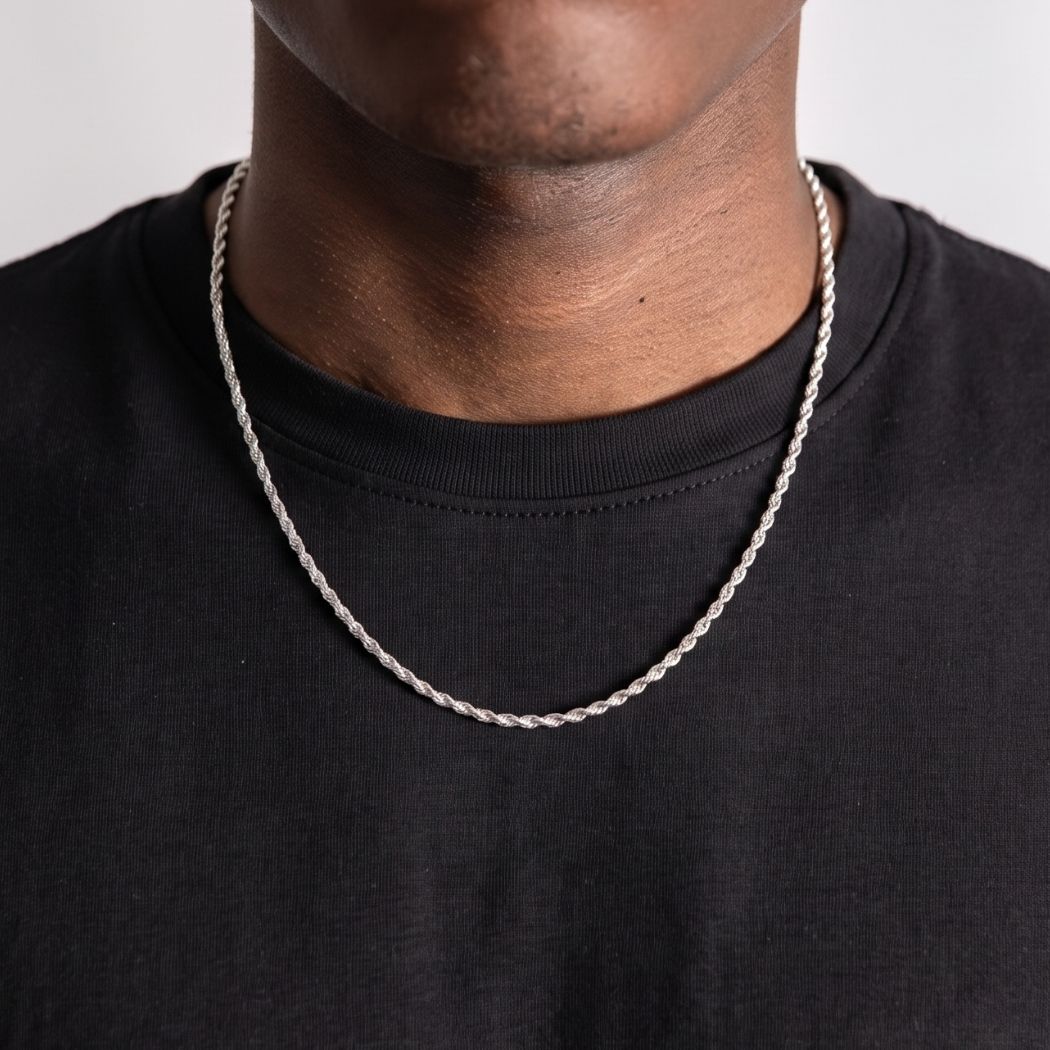
The 2.5mm runs in 50 cm (20in), 55 cm (22in) and 60 cm (24in), in silver and in gold plate. The 5mm in steel goes on to 50 cm (20in), 55 cm (22in), 65 cm (26in) and 75 cm (30in). At 50 cm (20in) it falls just below the collarbone, at 55 cm (22in) on the top of the breastbone, at 65 cm (26in) below the chest and at 75 cm (30in) down to the stomach.
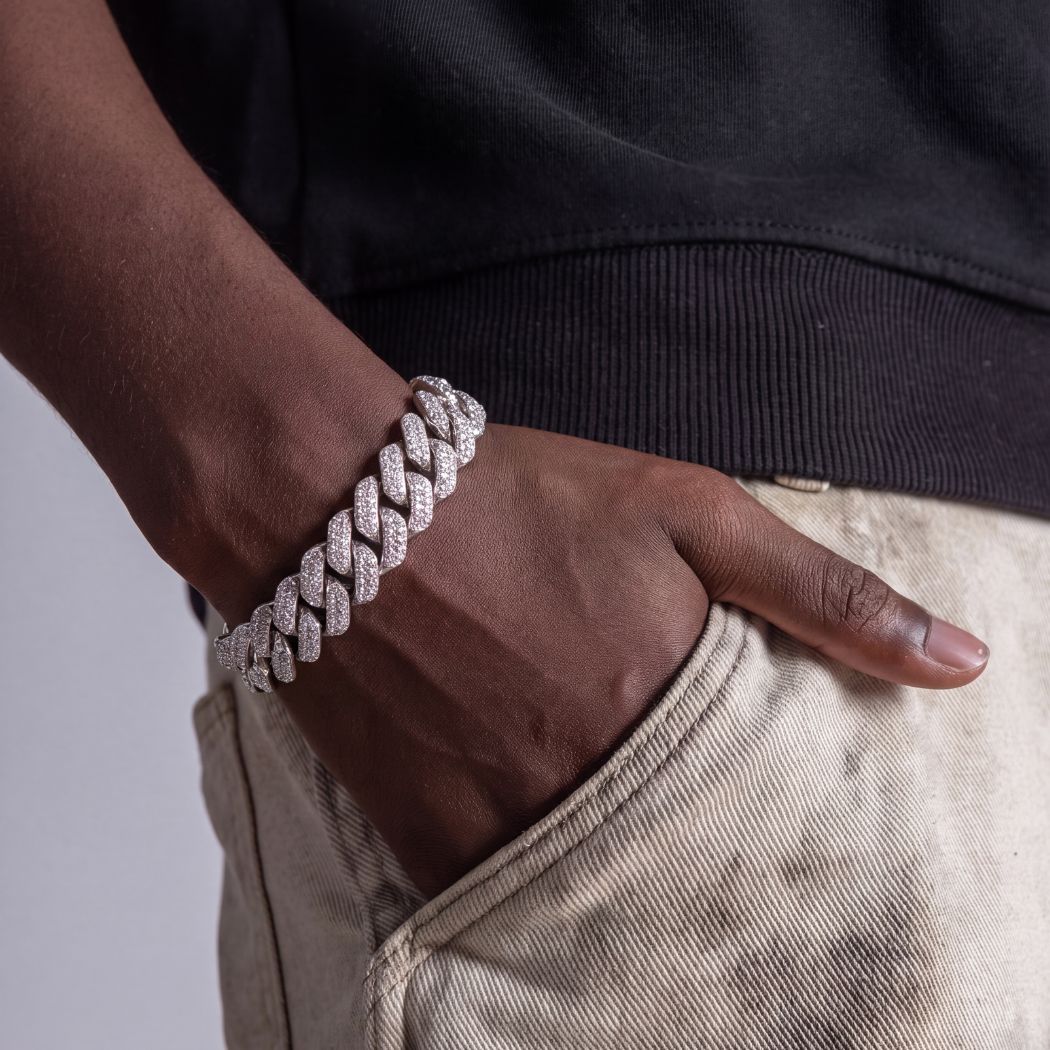
The same happens on a smaller scale with king's link bracelets, at 18, 20 and 22 cm (7.1, 7.9 and 8.7in). If you are unsure about your size, use the chain size chart.

5. Solid or hollow: the difference you cannot see
Two chains can be impossible to tell apart in a photo and still differ sharply in weight. A hollow link is built from metal that is empty inside: just as wide from the outside, with a fraction of the material in it.
That is not deception as long as it is stated. It only becomes a problem when it is left out, because then you are comparing two things that have nothing to do with each other. Hollow also dents sooner, and a dent in a braid cannot be fixed without opening the weave.
Our king's links are solid in all three constructions, and so is the 6mm byzantine. If you come across a suspiciously light-looking chain elsewhere, this is the first question to ask.

6. Where the price shows up in the jewelry
The four factors sit in the metal. They become visible in three places, and those are exactly the places you judge a chain on after a year.
The clasp. On any colored finish the layer wears there first, because that is the point you handle every day. Five layers of PVD last noticeably longer here than a thin electroplated layer, and that difference in production is part of what you pay for with stainless steel with PVD.
The inside of the links. In a braid the small links slide against each other constantly, so a layer wears from the inside out. On the gold plate a silver core appears there, which shows less than a different color of metal.
The depth of the weave. Solid 925 silver can darken between the links. That is tarnish and not wear, and a silver cloth takes it off. Dirt sits deeper in a king's link than in any other link, so dull here usually just means dirty.
7. What to ask when an offer looks too good
If you see a king's link chain priced strikingly low, there is nothing wrong with buying it. There is something wrong with buying it without knowing these five things, in order of how much they matter.
- Solid or hollow. This makes the biggest difference and is left out most often.
- The weight in grams. On a braid, weight is the most honest number there is, because it sums up width, length and hollowness in one figure.
- Which metal sits under the layer. Plated says nothing without the core. Silver, steel and base alloys all behave differently once the layer wears through.
- The layer thickness or the number of layers. With plating you ask about microns, with PVD about the number of layers.
- Width and length in millimeters and centimeters. Not in a trade name. Names like Monte Carlo or Magnum mean something different per supplier, millimeters mean the same everywhere.
Four mistakes you spot right away
- Comparing two chains on width alone. Without weight and without solid or hollow you are comparing two photos, not two chains.
- Assuming 5mm is double 2.5mm. The braid grows in three directions, so material rises faster than width.
- Saving on length and ending up too short. A chain that pinches at 50 cm (20in) is a chain you will not wear. Measure first.
- Mixing up gold plating and PVD. Two different techniques on two different cores, and they do not age the same way.
Where do you start?
Want as little maintenance as possible and still the full width? Then the 5mm king's link chain in silver color or the gold-colored version at 55 cm (22in) is the logical step: stainless steel, bare in silver color and with five layers of PVD in gold color.
Want a precious metal, and wear it under a shirt as well? Then the 2.5mm in solid 925 sterling silver comes into play, or the same link in 18K gold plate.
Want volume and depth? Then the 6mm byzantine is the end of the line; the difference between those two braids is explained in byzantine link versus king's link. You can look further in the king's link collection and at the king's link bracelets.
Frequently asked questions
What determines the price of a king's link chain?
Four things together: construction, width, length, and whether the link is solid or hollow. Construction weighs heaviest, because stainless steel, solid 925 sterling silver and 18K gold plate over a silver core differ most as raw materials.
Why does a narrow silver king's link chain cost more than a wider one in steel?
Because with solid 925 sterling silver you pay for the precious metal itself, while with stainless steel you mainly pay for the braiding and, on the gold-color version, the five layers of PVD. Width says nothing without the construction alongside it.
Is 5mm twice as expensive as 2.5mm?
No. The braid grows in three directions at once, so twice as wide means a multiple of the metal rather than double. On top of that, our 2.5mm and 5mm are made of different materials.
Are the king's link chains at Carpe Ice solid or hollow?
Solid, in all three constructions, and the 6mm byzantine as well. With an offer elsewhere, solid or hollow is the first question to ask, because that difference does not show in a photo and shows immediately in the weight.
Which lengths are there and which do I choose?
The 2.5mm runs in 50 cm (20in), 55 cm (22in) and 60 cm (24in), the 5mm in steel in 50 cm (20in), 55 cm (22in), 65 cm (26in) and 75 cm (30in). At 55 cm (22in) it falls on the top of the breastbone, the safest choice for most wearers.
Where does the gold layer wear first?
At the clasp and on the inside of the links, because that is where the most friction is. On the 18K gold plated version a core of 925 sterling silver appears there.