


How a king's link chain is made, and why it does not kink
Put a 5 mm king's link next to a flat chain of the same 5 mm and pick them both up. The king's link weighs more, feels stiffer, and drops straight instead of falling into a loop. That difference is not in the metal, it is in the way the links hold each other.
This article is about the object itself: how the weave is built and what that construction means the moment you wear it. If you want to know which types exist and how to choose, that is in the complete guide to king's link chains. Where the price comes from is covered in what determines the price of a king's link chain. And the difference with the other weave is in byzantine link versus king's link.

1. The weave: four grip points per link
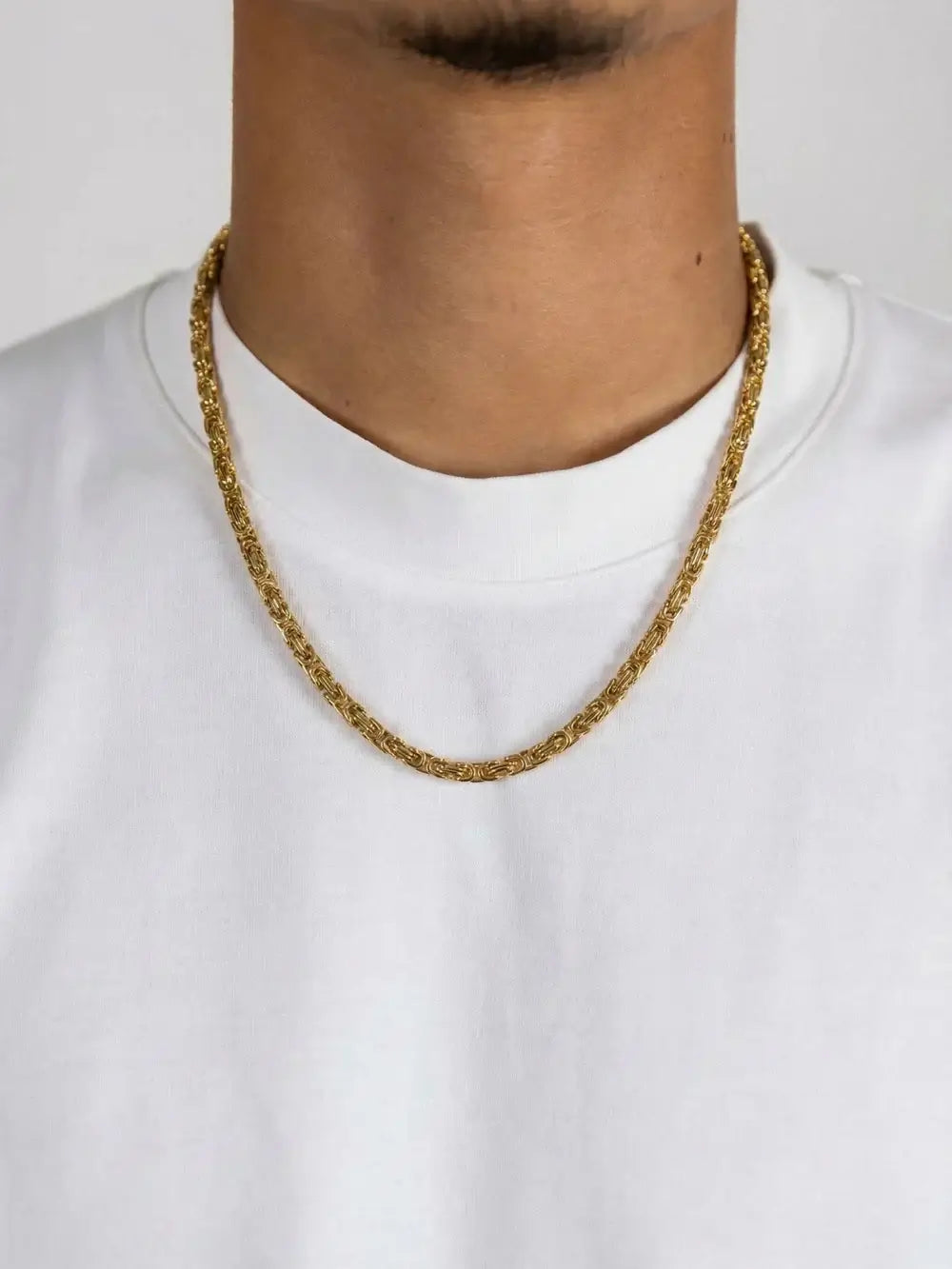
A king's link is not a row of loose rings in single file. It is built from small oval links hooked into each other layer by layer, and every link grabs four neighbors at once: one above, one below, and on either side the link that closes the layer alongside it.
On a flat chain, a Cuban or a Figaro, each link holds exactly two: the one before it and the one after it. Those two points sit on a straight line, and that line works as a hinge. That is why a flat chain can flip from wide to narrow against your skin.
With four grip points that line no longer exists. For a link to tilt it has to take four neighbors with it, and those are each fixed to four others, so every link keeps only a couple of degrees of play. That single fact explains almost everything that follows.
2. Why it does not twist and does not kink
Roll up a fine flat chain, leave it in a bag for a day and there is a good chance you take it out with a kink in it. That is the hinge line at work: links tilt until they sit crosswise, two crosswise links jam each other, and that is your kink.
A king's link never reaches that position. No link turns far enough to sit crosswise, so the strand stays round and even, even after it has been rolled up. You take it out of the box and it lies right straight away.
What does move is the strand as a whole: all those links together bend smoothly along its length, so the weave follows the shape of your neck. Stiff across, supple along, and on the 5 mm in stainless steel you notice it most clearly.

3. Weight against width
Width is a poor measure of how much metal you are holding with this link. A flat link is wider than it is thick: it lies on the skin like a ribbon. A king's link is close to square in cross section, so 5 mm wide here also means roughly 5 mm high. On top of that the weave is not hollow inside: where a flat chain has air between two rings, this one has the next layer of links.
At the same stated width a king's link therefore carries noticeably more metal per centimeter. That is why a 5 mm king's link chain feels heavier than the number suggests, and why you can comfortably drop one width step with this weave. Length works the same way: the 5 mm runs in 50 cm (20in), 55 cm (22in), 65 cm (26in) and 75 cm (30in), and there is half as much weave again between the shortest and the longest.

4. Three builds, three ways of aging
The same weave comes in three builds, and the construction decides where you see wear first each time.
Stainless steel, bare or with five layers of PVD. This is the 5 mm, in gold color and silver color. The silver-color version is polished stainless steel with no coating. On the gold-color version the color is bonded to the steel at molecular level in a vacuum chamber rather than electroplated, which makes the finish harder than an ordinary plated layer. That suits this weave, because four grip points per link are also four places where metal slides against metal. If you see anything, you see it at the clasp.
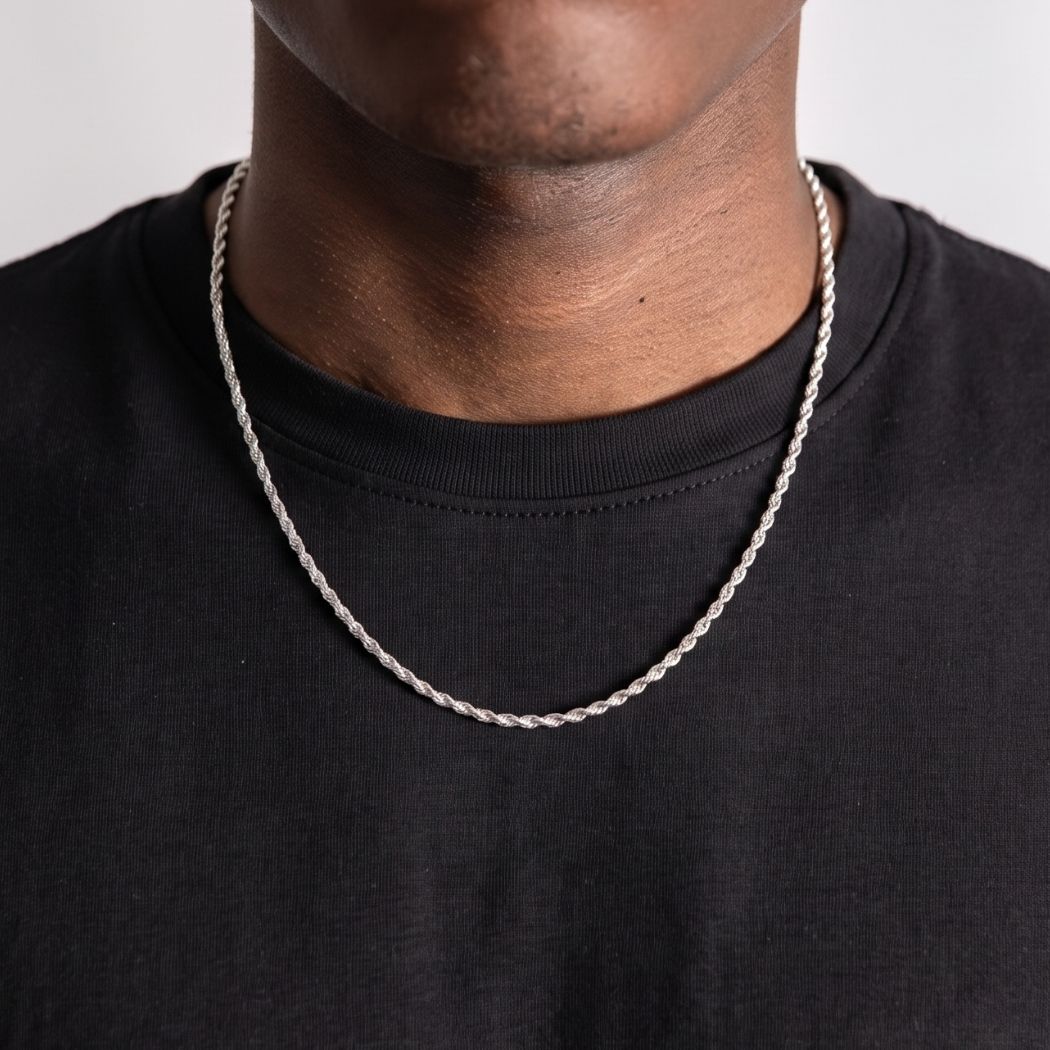
Solid 925 sterling silver. This is the 2.5 mm: 92.5% pure silver, topped up with copper because pure silver is too soft to wear. There is no layer around it that can wear off, what you see is the metal itself. Silver darkens over time, and on this weave that starts inside the loops where air barely reaches. It makes the pattern deeper; if you want it gone, a jeweler can polish the strand.
18K gold plated, 2.5 microns over a silver core. This is the 2.5 mm in plated. A micron is a thousandth of a millimeter, so the layer is 0.0025 mm, and the core underneath is solid 925. If the layer wears through on a high point, silver appears there rather than a base metal, so it shows less.

5. Two widths, and why there is nothing in between
We carry the king's link in 2.5 mm and in 5 mm. There is nothing in between, and that follows from the construction.
At 2.5 mm you only read the weave at conversation distance: from a meter away you see a smooth strand. That is the version for under a shirt, in 50 cm (20in), 55 cm (22in) and 60 cm (24in). At 5 mm the pattern reads across a room, because the links are large enough to each cast their own shadow. That is where the weave becomes recognizable as a weave rather than as a thick chain.
In between it ends up being neither: too heavy to disappear under a collar, too fine to let the pattern work at a distance. The only wider weave we carry is the byzantine at 6 mm, and that is a different construction with its own reason to exist.
6. The clasp on a heavy link
Every king's link we sell closes with a lobster clasp, and that part deserves more attention here than on a fine chain: the weight of a dense strand hangs in its entirety from the smallest part of the piece. So listen for the clasp clicking shut, because on a wide weave you cannot see the spring sitting.
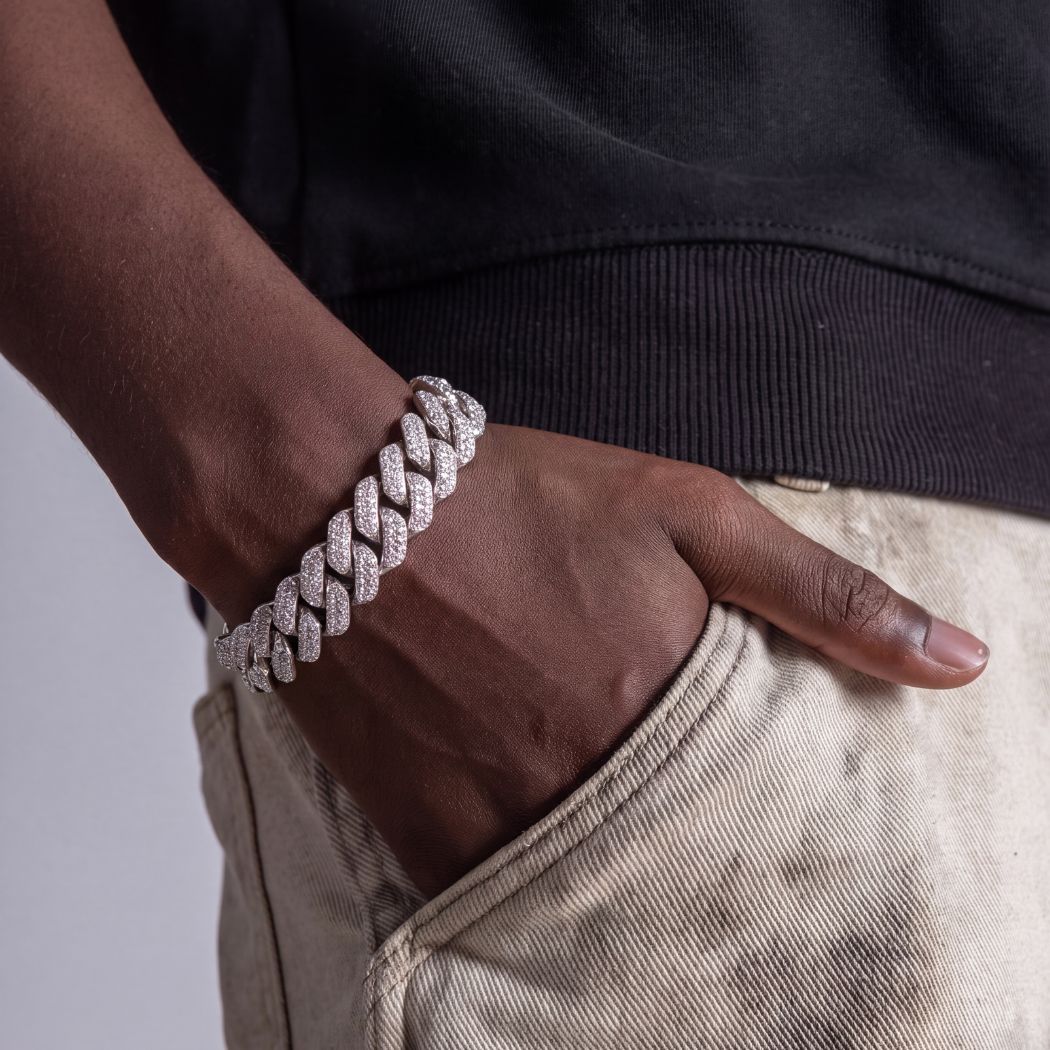
Also watch where the clasp ends up. On a 5 mm king's link bracelet it travels to the top of your wrist if the bracelet sits too loose, and then you spend the day looking at the clasp. The bracelets run in 18, 20 and 22 cm (7.1, 7.9 and 8.7in), in gold color too and in the fine 2.5 mm, in 925 sterling silver and in 18K gold plated. On a chain the clasp slides forward faster at 75 cm (30in) than at 50 cm (20in); turn it back when you feel it.

7. Care: dirt sits in the grip points
Four grip points per link are also four small cavities you cannot reach with a cloth. Soap, skin oil and dust collect there, and those cavities are exactly what make the shadow that keeps the pattern visible. Once they are full the weave goes flat and the chain looks dull. That is dirt, not wear.
Lukewarm water, a drop of mild soap and a soft toothbrush along the length of the strand get it out. Rinse, then dry the chain properly, because water left in the cavities does not come out by itself. A darkened silver strand you bring back with a silver cloth. Do not use an ultrasonic bath or an abrasive, and keep one order: perfume, deodorant and cream first, let it dry, chain on after.
Four mistakes you spot immediately
- Comparing widths across two different link types. 5 mm of king's link is not the 5 mm of a flat chain: the cross section here is close to square and the weave is filled inside.
- Storing the chain damp. Water stays in the grip points, exactly where a cloth cannot reach.
- Checking the clasp by eye. On a wide weave you cannot see the spring. Listen for the lobster clasp clicking shut.
- Attacking a dull weave with an abrasive. Nothing is worn out; there is dirt in the cavities.
Where do you start?
If you want the weave to show as a weave, the 5 mm in stainless steel at 55 cm (22in) is the logical start. If you wear it every day, including under a shirt, take the 2.5 mm: solid 925 sterling silver, or 18K gold plated for gold color over a silver core.
Everything side by side is in the king's link chains. If you want a set, pick a bracelet in the same width and the same tone from the king's link bracelets, or browse the full king's link collection. If the weave suits the rest of what you wear, look further in jewelry for him.
Frequently asked questions
How is a king's link chain constructed?
From small oval links hooked into each other layer by layer. Every link is held on four sides by its neighbors. On a flat chain there are two.
Why does a king's link chain not kink?
Because the four grip points leave no hinge line. Every link keeps only a couple of degrees of play and can never sit crosswise, and a kink is exactly what two crosswise links jamming each other create.
Why does a king's link chain feel heavier than a flat chain of the same width?
The cross section is close to square, so 5 mm wide here also means roughly 5 mm high, and the weave is filled inside with the next layer of links. At the same width there is therefore more metal per centimeter.
Which king's link widths does Carpe Ice carry?
2.5 mm in solid 925 sterling silver and in 18K gold plated, in 50 cm (20in), 55 cm (22in) and 60 cm (24in), and 5 mm in stainless steel (bare in silver color, with five layers of PVD in gold color), in 50 cm (20in), 55 cm (22in), 65 cm (26in) and 75 cm (30in). The byzantine weave comes in 6 mm.
Which clasp does a king's link chain have?
A lobster clasp, on every version and on the bracelets in 18, 20 and 22 cm (7.1, 7.9 and 8.7in). Listen for it clicking shut, because the whole weight of the weave hangs from that one part.
How do you clean a king's link chain?
Lukewarm water, mild soap and a soft toothbrush along the length of the strand, then dry it properly. No ultrasonic bath and no abrasive: a dull weave is almost always dirt rather than wear.