

What Does Iced Out Mean? Stones, Settings and Widths Explained
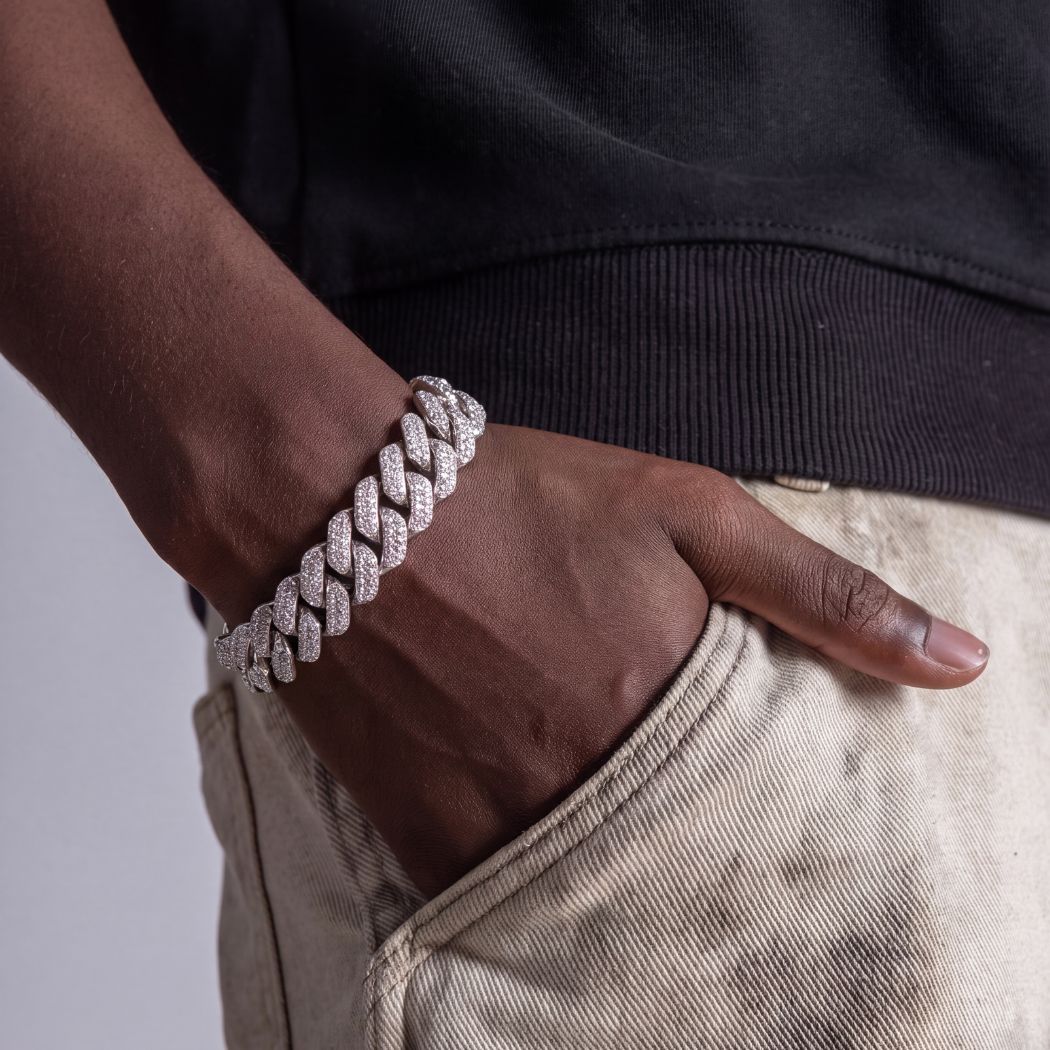
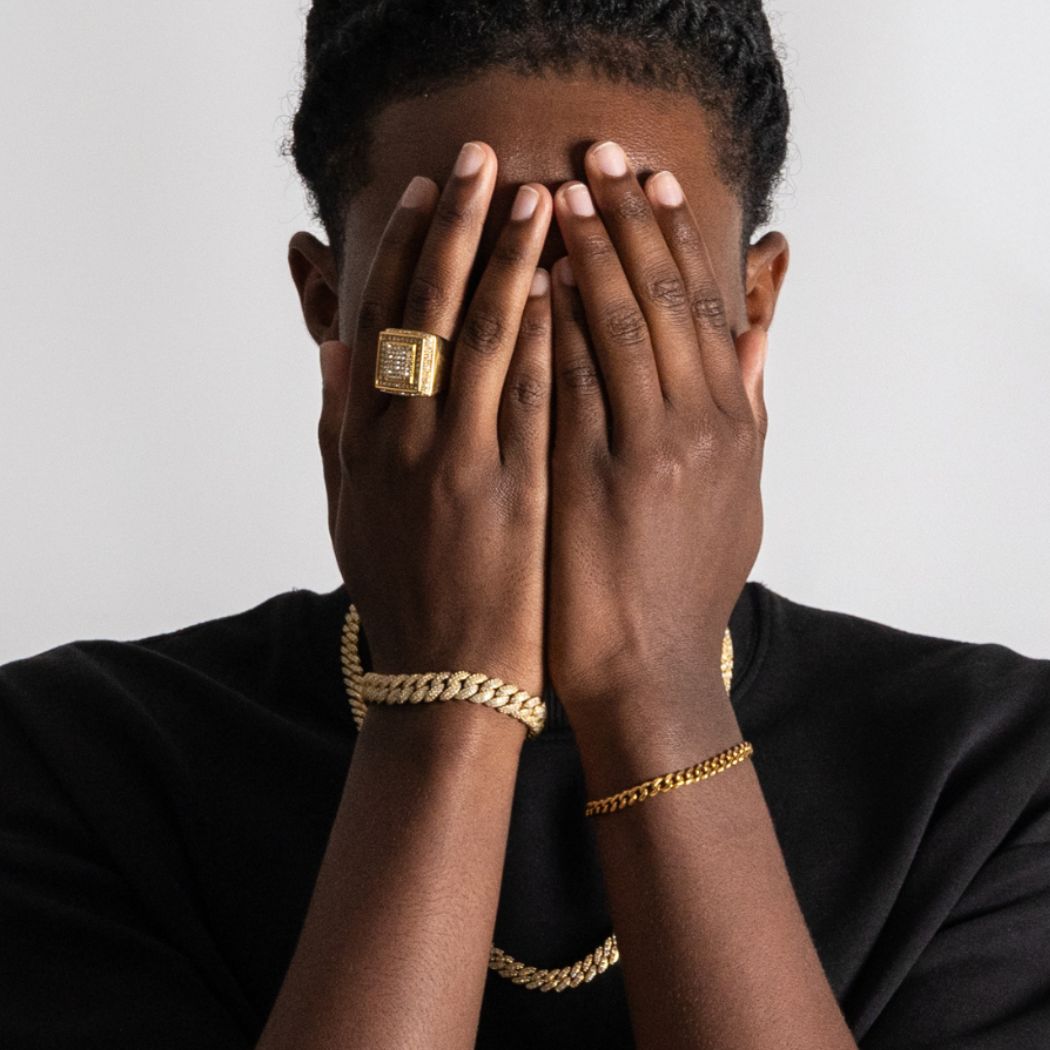
Iced out is not a material, not a hallmark and not a quality grade. It describes how much metal disappears underneath the stones. A link with a row of stones along the edge is not iced out. A link where the only metal you still see is the walls between the stones, that one is.
That is why prices run so far apart on pieces that look identical in a photo. This article explains where the term comes from, what is actually in those stones, and what to look at when you have two chains side by side.

1. Where the word comes from
In American hip hop slang, ice has meant diamond since the 1980s. Iced out meant, literally, covered all over in ice. The term moved from rappers to the jewelry itself and then became a product category, whichever stone happens to be in it.
That last part is exactly where the confusion starts. Iced out says something about coverage, not about material. A chain with cubic zirconia on an alloy and a chain with moissanite on 925 silver are both iced out. They differ in almost everything else you might want to ask about.
There is no real English alternative either. You occasionally see "fully paved" or "fully set", but in stores and online almost everyone searches for iced out. So that is what we call it, and you will find the whole line under iced out jewelry.

2. What is actually in those stones
There are three in practice, and the differences are measurable rather than a matter of taste. Hardness is measured on the Mohs scale, 1 to 10. Fire is dispersion: how strongly the stone splits white light into color.
| Stone | Hardness (Mohs) | Refractive index | Dispersion |
|---|---|---|---|
| Cubic zirconia (CZ) | 8 to 8.5 | 2.15 to 2.18 | 0.058 to 0.066 |
| Moissanite | 9.25 | 2.65 to 2.69 | 0.104 |
| Diamond | 10 | 2.42 | 0.044 |
Read that last column again. Moissanite has more than twice the fire of diamond, 0.104 against 0.044, and that is a physical property of the material rather than marketing. It is why moissanite looks more rainbow-like than a diamond of the same size in bright light. Some people want exactly that, others find it too much.
Cubic zirconia is mid range on fire and lowest of the three on hardness. At 8 to 8.5 it does not scratch easily, but after years of wear the facet edges go visibly blunter, and that is what you eventually notice as "gone dull". With moissanite that happens a good deal later than with cubic zirconia.
3. The setting decides whether it looks real or cheap
This is the part almost no one looks at, and it is exactly where the difference sits. There are two ways to hold a stone. In a prong setting, four small metal claws hold each stone individually. In a glue setting, the stone sits in a milled recess with adhesive underneath.
You can see the difference with the naked eye if you tilt the piece. With prongs you see four small points sitting over the edge of every stone. With glue the transition from stone to metal is smooth, and you sometimes catch a thin shiny line where adhesive has seeped out.
Why it matters: glued stones come loose. Not all of them, not immediately, but the first one to go leaves the gap you can never unsee. And you cannot put the piece in an ultrasonic bath, which is the easiest way to get an iced out piece clean again.
Also check the height: do all the stones sit on one plane, or does the row wobble? An uneven row means the recesses were not milled to depth, and that is the cheapest way to save time.

4. What VVS means, and what it does not mean here
VVS stands for Very Very Slightly Included and comes from the clarity scale the GIA uses for diamond. That scale runs from FL and IF through VVS1 and VVS2 to VS, SI and I. VVS means there are inclusions, but a trained grader has trouble finding them at ten times magnification.
That scale was built for natural diamond. On cubic zirconia it is technically meaningless, because cubic zirconia is grown in a furnace and has no natural inclusions of its own. When a store writes "VVS cubic zirconia", that is not a grade but a way of saying: clear, no visible cloudiness, cleanly cut.
With moissanite there is slightly more to it. Moissanite is graded on color, usually with a letter such as D, E or F for the colorless qualities. A label like "VVS D" then means colorless and without visible inclusions. Useful to know, but it is not a GIA certificate and it should not sound like one.
What that means in practice: treat VVS as an indication of clarity, not as proof of value. What you can actually check is the setting, the hardness of the stone and the base metal.
5. Which width to choose
Iced out behaves differently from a plain chain. On a plain link the width decides how heavy it looks. On iced out the width mostly decides how much light it catches, and that scales faster than the millimeters suggest.
Our iced out cuban chain runs in 6, 8 and 10 mm. Roughly: 6 mm stays subtle and works under an open collar. 8 mm is the point where people notice it without you saying anything. 10 mm is a statement, and it leaves little room for anything next to it.
The interesting part is that 10 mm is our best selling width, not 6 mm. Someone buying an iced out chain usually buys it because it is meant to be seen. The 12 mm moissanite cuban is the upper limit of what we carry, and you wear that one on its own, not in a stack.
If you want something fully set without the width, look at a different link shape. The 7 mm honeycomb chain catches a lot of light at a modest width thanks to its open honeycomb structure.

6. Why prices run so far apart
Four things decide what an iced out piece costs, and they stack on top of each other.
- The surface. A 10 mm chain does not carry 1.7 times as many stones as a 6 mm one but closer to three times, because the setting grows in two directions at once. More stones means more setting work, and setting work is done by hand.
- The stone. Moissanite costs a multiple of cubic zirconia at the same size. That is the biggest jump on this whole list.
- The base metal. On most iced out pieces, what sits under the stones is a copper alloy with a plated finish. On the moissanite line and the clover pieces it is 925 sterling silver. Solid silver is heavier, more expensive and repairable.
- The setting. Setting prongs costs time per stone. Gluing does not.
One thing that is not on that list, though you still hear it claimed: iced out is never solid gold with real diamonds for a normal amount of money. Not from us either, and we would rather say that out loud than let you work it out for yourself.
7. Color is the easiest way to stand out
Almost all iced out is clear white. That makes colored stones the cheapest way right now to wear something not everyone else has.
Two things to know. Colored cubic zirconia is usually the same material with a color additive, so hardness and behavior stay the same. And color works best when it stays a single accent: a cross pendant with blue stones on an otherwise white chain reads calmer than a fully colored chain.
Green is the other direction coming up, for instance in the 7 mm emerald bracelet. Pair it with white rather than a second color, or it gets messy fast.

8. Care: the setting is the problem, not the metal
Iced out does not turn black the way solid silver does. It goes dull, and that is almost always a film of soap, skin oil and body lotion sitting between the stones. Lukewarm water, one drop of dish soap and a soft toothbrush along the sides of the setting get it out in thirty seconds.
The step that makes the difference comes next: dry it completely, right away, including between the stones. Water left standing in the setting dries into a white haze, and that haze is the real reason people think the stones have lost their sparkle.
What not to do: no soaking in liquid silver dip, and no ultrasonic bath if there are glued stones in it. The full explanation per material is in our guide on how to clean silver jewelry.
Where do you start?
First iced out piece, and you want to see whether it suits you? Take an iced out bracelet instead of a chain. It sits on your wrist, you get used to it in a week, and it is not hanging up by your face from day one.
Want the chain right away? 8 mm from the iced out chains is the width fewest people regret as either disappointing or too much.
Looking for something smaller to start with? The iced out rings and the iced out pendants are the cheapest way in. And if what you are really after is the sparkle rather than the width, have a look at the tennis jewelry, because that is the same stone in a much narrower line.
Frequently asked questions
What does iced out mean?
Iced out means a piece is completely set with stones, so the only metal you still see is the walls between them. The term comes from American hip hop slang, where ice has meant diamond since the 1980s. It describes coverage, not material or quality.
Are there real diamonds in iced out jewelry?
Usually not. In practice it is cubic zirconia or moissanite. Cubic zirconia reaches 8 to 8.5 on the Mohs scale, moissanite 9.25 and diamond 10. Iced out with real diamond exists, but that is a completely different price bracket from what is normally sold online.
What does VVS mean on iced out jewelry?
VVS stands for Very Very Slightly Included and comes from the GIA clarity scale for diamond. On cubic zirconia that scale is technically meaningless, because cubic zirconia is grown in a furnace and has no natural inclusions. In store copy, VVS in practice means clear and without visible cloudiness.
What is the difference between cubic zirconia and moissanite?
Hardness and fire. Cubic zirconia is 8 to 8.5 on the Mohs scale, with a dispersion of 0.058 to 0.066. Moissanite is 9.25 on the same scale, and its dispersion of 0.104 is more than twice diamond's 0.044. Moissanite therefore keeps its facet edges sharper for longer and throws off more color flashes in bright light.
Which width iced out chain should I choose?
6 mm stays subtle and works under an open collar, 8 mm gets noticed without you having to explain it, and 10 mm is a statement that leaves little room for anything next to it. Our best selling width is 10 mm, because someone buying iced out usually wants to be seen.
Does iced out jewelry go dull?
It does not tarnish the way solid silver does, but it goes dull from a film of soap, skin oil and body lotion between the stones. Lukewarm water with a drop of dish soap and a soft toothbrush, thirty seconds, then dry it completely, right away. No silver dip, and no ultrasonic bath if the stones are glued.