


Cubic zirconia, moissanite or diamond: what you really see in a chain
From a meter away nobody can tell a row of cubic zirconia from a row of diamond. From fifteen centimeters you can, and what gives it away is not the sparkle but how sharp the facet edges still are.
We do not sell a diamond necklace. That is not a gap in the range but a decision: across a continuous row of dozens of stones the price difference runs up so far that the piece lands in a different category altogether. What we do sell is VVS cubic zirconia and VVS D moissanite. Below are the three numbers that decide what you actually see from each of the three.

1. What you mean by a diamond necklace
That search covers two very different pieces of jewelry. The first is a pendant with one stone on a thin chain. The second is a continuous row, where the metal does nothing but hold the stones in place.
The second is what most people picture, and that is where the arithmetic flips. Divide the length by the width and you are close to the number of stones: a 5 mm tennis chain at 55 cm (22in) carries roughly a hundred. With a pendant you pay the difference once, for one stone. In a row you pay it a hundred times, and at that point the stone is no longer a detail but the whole decision.
So the question of which diamond necklace to buy here has a short answer: none. If what you want is what a row of a hundred stones does at your neck, we carry two versions of exactly that.
2. The three numbers that make the difference
Hardness. On the Mohs scale diamond scores 10, moissanite 9.25 and cubic zirconia 8 to 8.5. That scale is a ranking, not a ruler: the step from 9 to 10 is far bigger than the step from 8 to 9.
Refractive index. Moissanite sits at 2.65 to 2.69, diamond at 2.42 and cubic zirconia at 2.15 to 2.18. The higher the number, the more light is bounced back inside the stone instead of leaking out the bottom. That is what decides whether a stone looks full or watery.
Dispersion. Moissanite comes in at 0.104, cubic zirconia at 0.060 and diamond at 0.044. Dispersion splits white light into colors: the rainbow flash you see when the piece moves.
Look hard at that last set, because it usually gets talked around: cubic zirconia at 0.060 already sits above diamond. More fire, then, is not an argument. The real distinction is hardness and refractive index.
3. Why a hundred stones add up differently than one
With a single stone on a pendant you have no reference. Whether the tint is half a grade off is something you only learn by holding a second stone beside it. In a row that second stone is always there, two centimeters away, which turns every small deviation into a visible one.
That goes for color and it goes for wear. A softened facet edge on one stone escapes everybody. The same edge in a row stands out the moment its neighbor is still crisp, because your eye compares on its own. With a hundred stones the odds that one of them meets a door frame are also a hundred times higher.
On a wrist this counts for even more than at the neck. That comparison is written out in full in the guide on moissanite, cubic zirconia and lab diamond in a tennis chain.
4. What we do sell, and what it is made of
The cubic zirconia line is the broad side. The silver-tone tennis chain and the gold-tone tennis chain both come in 3 mm and 5 mm, at 50 cm (20in), 55 cm (22in) and 60 cm (24in), with a box clasp. The base is a nickel-free copper alloy with five layers of PVD. That is not stainless steel and it is not silver. For more volume, the tennis cluster necklace runs 10 mm and 12 mm at 50 and 55 cm.
The moissanite line is the other side. The moissanite tennis necklace is 5 mm at 50, 55 and 60 cm, with VVS D stones on solid 925 sterling silver: 92.5% pure silver with copper, and no plating to wear through. The matching bracelet comes in 18 cm (7in) and 20 cm (8in), and wider still the moissanite Cuban link necklace goes to 12 mm.
One practical difference tends to surface late: copper alloy is more sensitive to moisture than stainless steel. So the cubic zirconia version does not go in the shower, to the gym or into a pool.

5. The GRA certificate, and what it is not
The moissanite necklace and the moissanite Cuban come with a GRA certificate. It records two things: that the stones are moissanite, and how they grade, in our case VVS for clarity and D for color.
D is the highest color grade there is, meaning completely colorless, without the yellow or gray undertone cheaper stones often carry. VVS stands for very very slightly included: inclusions that are hard to find even under a loupe. In a row of a hundred stones it is that color grade that matters most.
And what it is not: it is not a diamond certificate, and it does not pretend to be. Moissanite is silicon carbide, a gemstone in its own right, not a diamond and not a fake diamond. Nor is it a valuation. A certificate describes what you have, not what somebody will pay for it later.

6. The only real diamonds in the store
There is exactly one place in the catalog where natural diamond appears, and it is not a necklace. It is two pairs of earrings, the 14K white gold pavé earrings and the 14K rose gold pavé earrings, which together make up our entire diamond collection.
The figures, plainly: natural diamond, round brilliant cut, pavé set, color G and clarity SI2, 0.084 ct in total. The setting measures roughly 4.7 mm and fastens with a push-back, and the gold is solid 14K, meaning 585 parts gold per thousand.
G is the third step in the color scale that starts at D and counts as near colorless, indistinguishable from D inside a pavé grid. SI2 means inclusions visible under a ten times loupe but not to the naked eye at this stone size. That is exactly the grade you want in pavé: you are not paying for clarity you cannot see anyway.
And the honest footnote: at 0.084 ct you are not buying an investment, you are buying solid gold that does not wear off. A hundred of these little stones in a row puts a piece in a category this store is not about, and that is why no diamond necklace sits beside them.

7. Choosing width and length
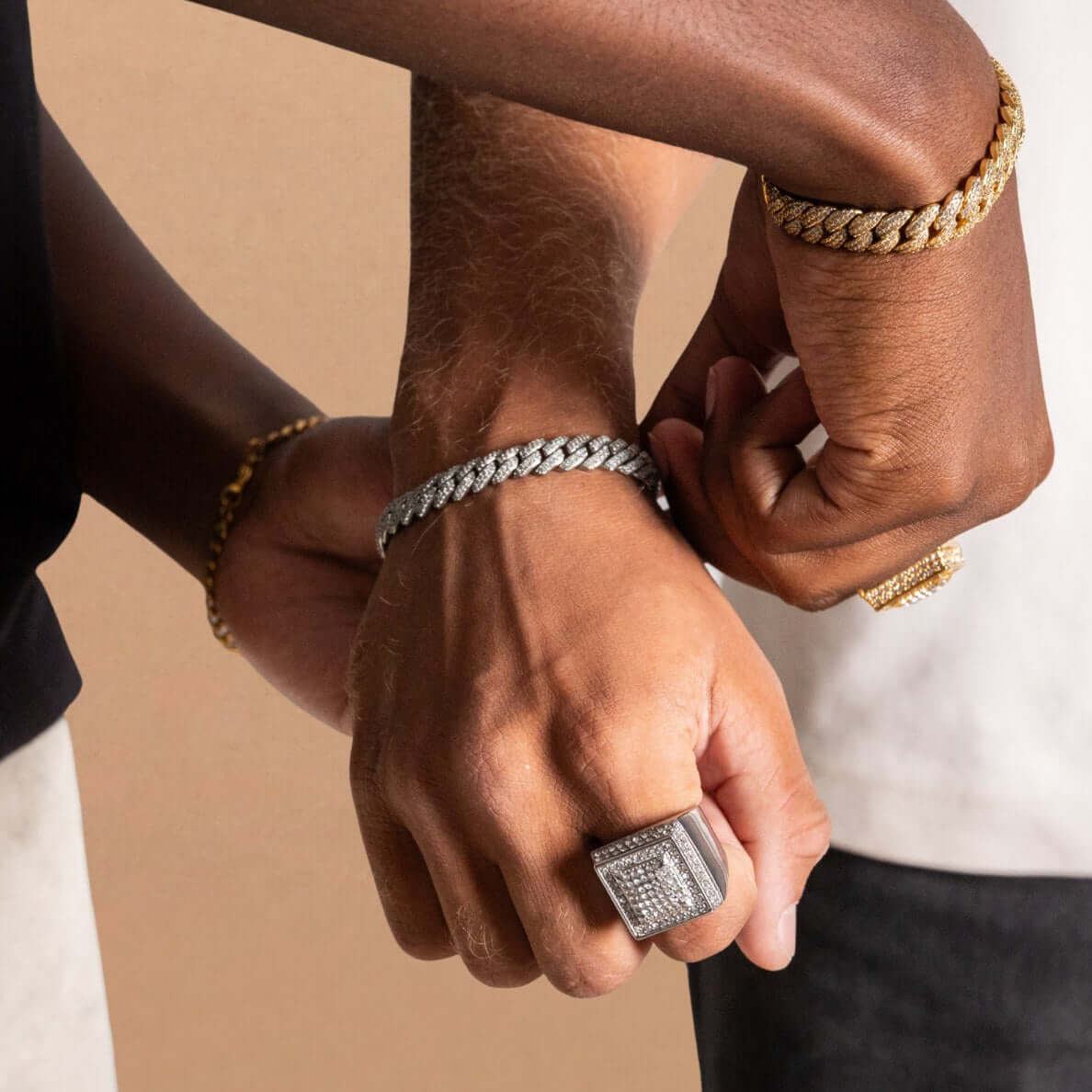
Width decides how much of the individual stone you see. At 3 mm the row melts into a single line of light, at 5 mm you read every stone separately and that is the most chosen width in the tennis collection. From 10 mm and 12 mm the piece reads as a block of light and belongs with the iced out chains.
Length works independently of that. At 50 cm (20in) the chain stays inside a buttoned shirt, at 55 cm (22in) it falls just below the collarbone and that is the size chosen most often, and at 60 cm (24in) it clears a T-shirt. At 10 mm or 12 mm, 60 cm is the logical pick, because a wide piece needs room.
Wearing two, keep them about 10 cm (4in) apart, or they slide over each other and the row of stones disappears behind the second strand. All the measurements are in the chain size chart.

Four mistakes you spot straight away
- Choosing on fire. Cubic zirconia at 0.060 dispersion sits above diamond at 0.044. Pick by rainbow flash and you end up with the softest stone.
- Taking the copper alloy into the shower. Our cubic zirconia sits on copper alloy with PVD, more sensitive to moisture than stainless steel. Take it off, at the gym too.
- Reading a certificate as proof of value. A GRA certificate describes the stone. There is no resale market for moissanite or cubic zirconia.
- Calling cubic zirconia or moissanite diamond. Zirconia is zirconium dioxide, moissanite is silicon carbide. That is why we never call either one diamond.
Where do you start?
If you want precious metal you can still have polished in ten years, start with the 5 mm moissanite tennis necklace at 55 cm (22in), and add the 5 mm bracelet if you want the pair.
If you want gold tone or a narrower 3 mm, the gold tennis chain or the silver tennis chain with VVS cubic zirconia is the step, and it goes wider with the tennis cluster necklace.
And if it really is diamond you are after, we will point you straight to the right corner: the rose gold pavé earrings. To browse further, there is the moissanite collection and the tennis collection.
Frequently asked questions
Does Carpe Ice sell a diamond necklace?
No. The only natural diamond in our catalog sits in two pairs of 14K pavé earrings: color G, clarity SI2 and 0.084 ct in total. For necklaces we carry VVS cubic zirconia on copper alloy and VVS D moissanite on solid 925 sterling silver.
What is the difference between cubic zirconia and moissanite in numbers?
Hardness 8 to 8.5 on Mohs against 9.25. Refractive index 2.15 to 2.18 against 2.65 to 2.69. Dispersion 0.060 against 0.104. The first two decide what you see after a year of wear, the third far less.
Is cubic zirconia a fake diamond?
Cubic zirconia is zirconium dioxide, a material in its own right sold as a simulated diamond. We never call it diamond. At a refractive index of 2.15 to 2.18 against 2.42 it returns less light than diamond, while its dispersion of 0.060 is actually higher than diamond's 0.044.
Why do you sell diamond earrings but no diamond necklace?
A 5 mm tennis chain at 55 cm (22in) carries roughly a hundred stones, because you divide the length by the width. The difference per stone therefore counts a hundred times over. On a pair of earrings totaling 0.084 ct it stays manageable.
What width and length should you pick for a tennis chain?
At 3 mm the row melts into a single line of light, at 5 mm you read every stone separately and that is the most chosen width. From 10 mm and 12 mm it reads as a block of light. At 50 cm (20in) it stays inside a shirt, 55 cm (22in) falls just below the collarbone and 60 cm (24in) clears a T-shirt.
Can a cubic zirconia chain go in the shower?
No. The cubic zirconia line sits on a nickel-free copper alloy with five layers of PVD, which is more sensitive to moisture than stainless steel. Take it off at the gym and at the pool as well.