

The Best Moissanite Jewelry: What to Buy and Why
Put a moissanite next to a diamond and the first difference you notice is not the clarity. It is the color. Moissanite throws off more than twice as many colored flashes, and that is not a matter of taste but a measurable property.
That makes the question of which moissanite jewelry is best a lot more concrete than it sounds. The answer depends on what the piece has to do: sparkle from a meter away, survive daily wear, or sit beside something you already own. This guide walks the collection on those three points.

1. What moissanite is, and what it is not
Moissanite is silicon carbide. It occurs in nature, but so rarely that virtually everything you can buy is made in a laboratory. That does not make it an imitation: it is a gemstone in its own right with its own properties, and on some points those properties beat diamond.
The distinction from cubic zirconia matters more than most shops let on. Zirconia is a cheaper stone that scores around 8 to 8.5 on the Mohs hardness scale. Moissanite scores 9.25, diamond 10. In practice that means a stone that keeps its sharp facet edges instead of looking soft and dull after a year of daily wear.
Alongside moissanite, Carpe Ice also carries lab grown diamond. That is chemically diamond, just not out of the ground. If you specifically want diamond, choose there. If you want maximum sparkle per euro, you end up at moissanite.

2. The three numbers that make the difference
Refractive index 2.65 against 2.42. Moissanite bends light more strongly than diamond and therefore returns more white light.
Dispersion 0.104 against 0.044. This is the number that really counts. Dispersion splits white light into colors, and moissanite does that more than twice as strongly as diamond. Those are the rainbow flashes you see when the stone moves.
Mohs 9.25 against 10. Diamond stays harder, but above 9 the difference is not noticeable in daily wear. Below 9 it is, and that is where zirconia sits.
Taken together: you buy more visible sparkle and give up almost nothing in wear resistance. On a large stone you see it most clearly, because there is more surface for the effect to show on.
3. What to check before you buy
Stone quality. All moissanite in this collection is VVS D. VVS is the clarity grade, D is the color grade, and that is the colorless top of the scale. If a stone carries no quality grade at all, do not assume it is a good one.
The metal underneath. These pieces have a base of solid 925 sterling silver with white gold plating over it. That plating keeps the silver cool in tone and holds off tarnish. It stays a finish, so on a ring it wears faster than on earrings, simply because your hands touch everything.
Where the light gets in. On a set stone the light enters from underneath. Grease and soap on the underside of the setting therefore cost you sparkle straight away, and in nine out of ten dull stones that is the real cause. Not a quality problem, just dirt.
Certificate. The studs ship with a certificate. Always ask for one, because it is the only hard proof that the stone is what the seller says it is.
4. The best moissanite earrings
This is the category where moissanite comes into its own, because an earring is at exactly eye level for the person opposite you.
The round 5 mm studs are by far the best selling moissanite piece in the shop, and that makes sense: 5 mm reads from a meter away and is small enough to wear all day. This is also the safest size to wear under a beanie.
If you want more presence, the square 7.5 mm version is the step up. The square cut catches light differently from a round one and stands out because it breaks the classic picture.
The halo studs of 5 mm set a ring of small stones around the main stone, which makes the whole read larger than the center stone is. If you would rather not wear studs, there are the moissanite hoops. Everything sits together in the moissanite earrings.

5. The best moissanite ring
With rings there are two choices to make, and they go in opposite directions.
The solitaire ring with a 5 mm stone hangs everything on that one stone. Which is exactly why the type of stone counts for more here than on any other piece: in a row of small stones the rest compensates for a dull one, on a solitaire you see every scratch on a facet edge. It runs in sizes 5 through 9.
The tennis ring does the opposite: a continuous row of stones around the band that sparkles from every angle rather than from one. That one runs in sizes 7 through 9.
Measure your size at the end of the day, because fingers are slightly thicker then than in the morning. On a ring with a raised stone, do not size up too generously, or the stone turns to the side of your finger and you lose exactly the effect you paid for.

6. Necklace and bracelet: 5 mm or 12 mm
For the neck and the wrist the choice is mostly about how hard you want it to speak.
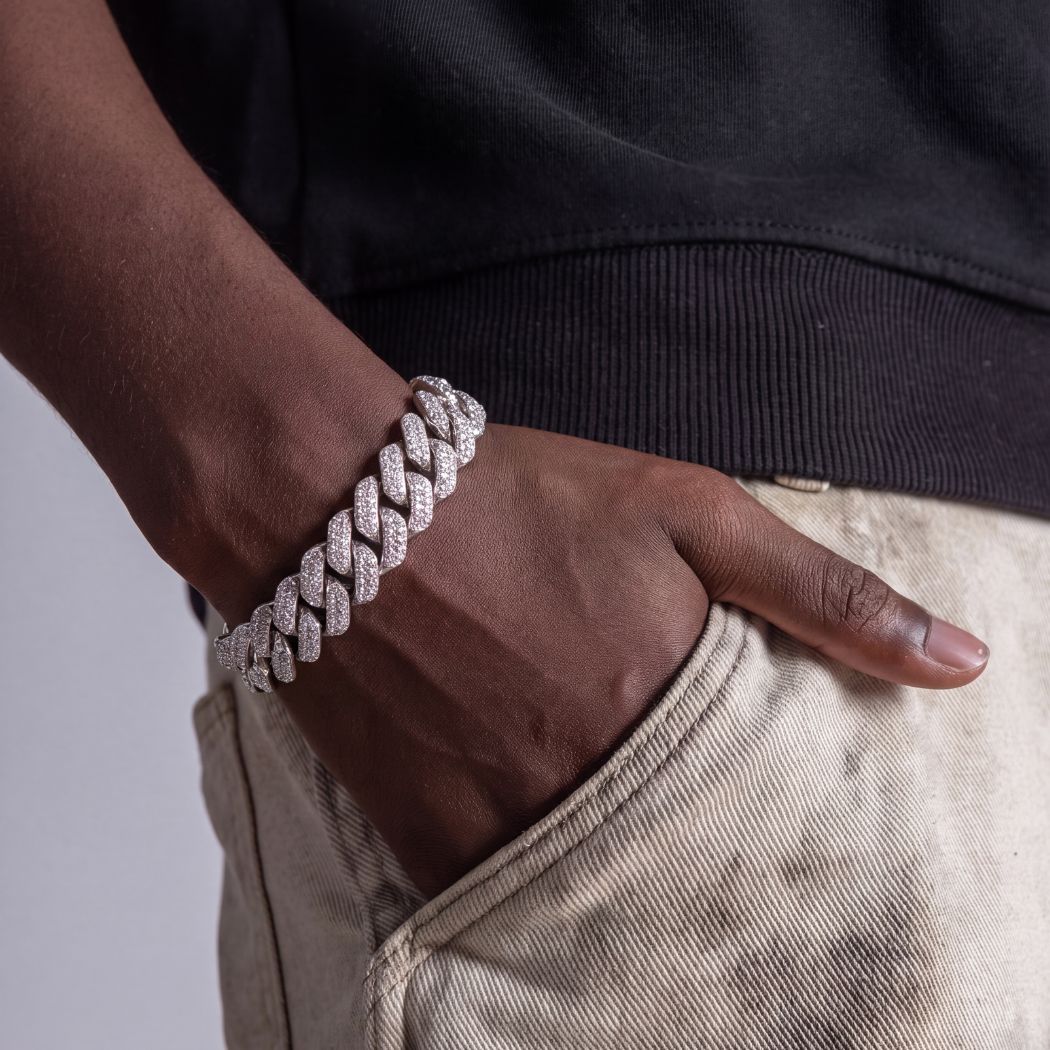
The 5 mm moissanite tennis necklace is a continuous row of set stones from clasp to clasp, in 50 cm (20in), 55 cm (22in) and 60 cm (24in). The matching tennis bracelet runs in 18 and 20 cm (7.1 and 7.9in). Wearing both works, but then the rest of your look is better left empty.
If you want more mass, the 12 mm moissanite Cuban link chain is the heaviest piece in the collection. Twelve millimeters is wide: this is jewelry that takes over an outfit rather than completing it. Wear one at a time and keep the rest small. You will find more in the same style in the iced out collection.

7. Four mistakes that cost you sparkle
- Not cleaning the underside of the setting. That is where the light gets in. A stone that has gone dull is almost always a dirty stone.
- Using an ultrasonic bath. That is meant for solid metal without a finish, not for a set stone with plating.
- Perfume or hairspray after putting them on. Spray first, put the jewelry on afterwards. Alcohol attacks the plating.
- Two statement pieces at once. A tennis necklace next to a 12 mm Cuban makes both look smaller. Pick one.
Care in thirty seconds
Lukewarm water, a drop of mild soap and a soft toothbrush along the underside of the stone. Dry afterwards with a soft cloth. Nothing more is needed and nothing more should be done.
Take moissanite off for swimming and sport. Not because the stone would notice, but because the white gold plating underneath is a finish. If it does wear through, silver appears and a jeweler can have it replated.
Where do you start?
No moissanite yet? Start with the 5 mm studs. It is the safest first purchase, the best selling piece, and you will wear it literally every day.
Looking for one piece that stands out? Then the 5 mm solitaire ring is the clearest choice, because one large stone shows exactly what moissanite is good at.
See the full moissanite collection, or compare first with the tennis jewelry and the earrings in other stones.
Frequently asked questions
Which moissanite piece is best to start with?
The round 5 mm studs. They are the best selling moissanite piece in the shop, large enough to read from a meter away and small enough to wear daily.
Does moissanite sparkle more than diamond?
Yes, measurably. Dispersion is 0.104 against 0.044 for diamond, more than double, and dispersion is what causes the colored flashes. The refractive index is 2.65 against 2.42.
Is moissanite the same as cubic zirconia?
No. Moissanite is silicon carbide and scores 9.25 on the Mohs hardness scale. Zirconia scores 8 to 8.5 and therefore loses its sharp facet edges sooner in daily wear.
What does VVS D mean on moissanite?
VVS is the clarity grade, D is the color grade and that is the colorless top of the scale. All moissanite in this collection is VVS D.
Why does my moissanite look dull?
Almost always grease on the underside of the setting, because that is where the light gets in. Lukewarm water, mild soap and a soft toothbrush fix it. Do not use an ultrasonic bath.
Which size moissanite earrings should you choose?
5 mm reads clearly without becoming a statement. 7.5 mm in the square cut is the step up if you want more presence.