


Article: Clover pendant: what you need with it and which stone is set in it
Clover pendant: what you need with it and which stone is set in it
Most people order a clover pendant and assume a chain comes with it. It does not. You are buying two things: a pendant measuring 2.1 by 3.8 cm and a strand to carry it.
At that size the chain is not an afterthought. A pendant almost four centimeters tall pulls on a single point, and what hangs below decides whether the clover stays upright or slumps sideways. This guide covers the clover pendant silver iced out: its real size, which link and which width belong under it, and why the stone in the pendant carries a different grading than the one in the bracelet from the same line.

1. The pendant, and what 2.1 by 3.8 cm really means
The stated size is 2.1 cm wide by 3.8 cm tall, including the bail the chain passes through. The clover leaf itself takes up roughly the bottom two centimeters.
Put that next to what you are used to. A pendant starts reading as a statement around 15 mm; above that it registers from a meter away as a shape rather than an accent. At 21 mm wide this one sits well above that mark, and at 38 mm it drops about as far as three fingers are wide.
The base is solid 925 sterling silver, meaning 92.5 percent pure silver with copper added for strength. There is no coating on top: the precious metal is in the piece itself, not in a coating around it. Every leaf is fully set with cubic zirconia. You will find more pieces built this way in iced out pendants.

2. No chain is included, and that is deliberate
This is where most orders go wrong. The clover pendant ships on its own, in a Carpe Ice jewelry box, without a chain. If you want to wear it, you pick the strand yourself.
That sounds awkward but it is not. Anyone already wearing a necklace simply hangs the clover on what is already there. Anyone starting fresh picks the width that suits their shoulders instead of the width that comes bundled as standard.
In a set sold as a whole, the chain included is almost always the lightest component, and it is the first thing to give out. Choosing the strand separately lets you decide where the material goes. Remember only this: without a chain you cannot wear the pendant, so add one to the same order.
3. Which link belongs under it, and in which width
One rule decides everything: a pendant pulls on a single point, and a flat link rotates under that pull. Cuban, figaro and jubilee are flat families. Hang 3.8 cm of clover on one and the chain tips around its own axis, leaving the clover sitting at an angle.
Round strands do not do that. They have no flat face that can rotate upward, so the pendant stays hanging the way you hung it. That leaves four families: box, rope, franco and king's link.
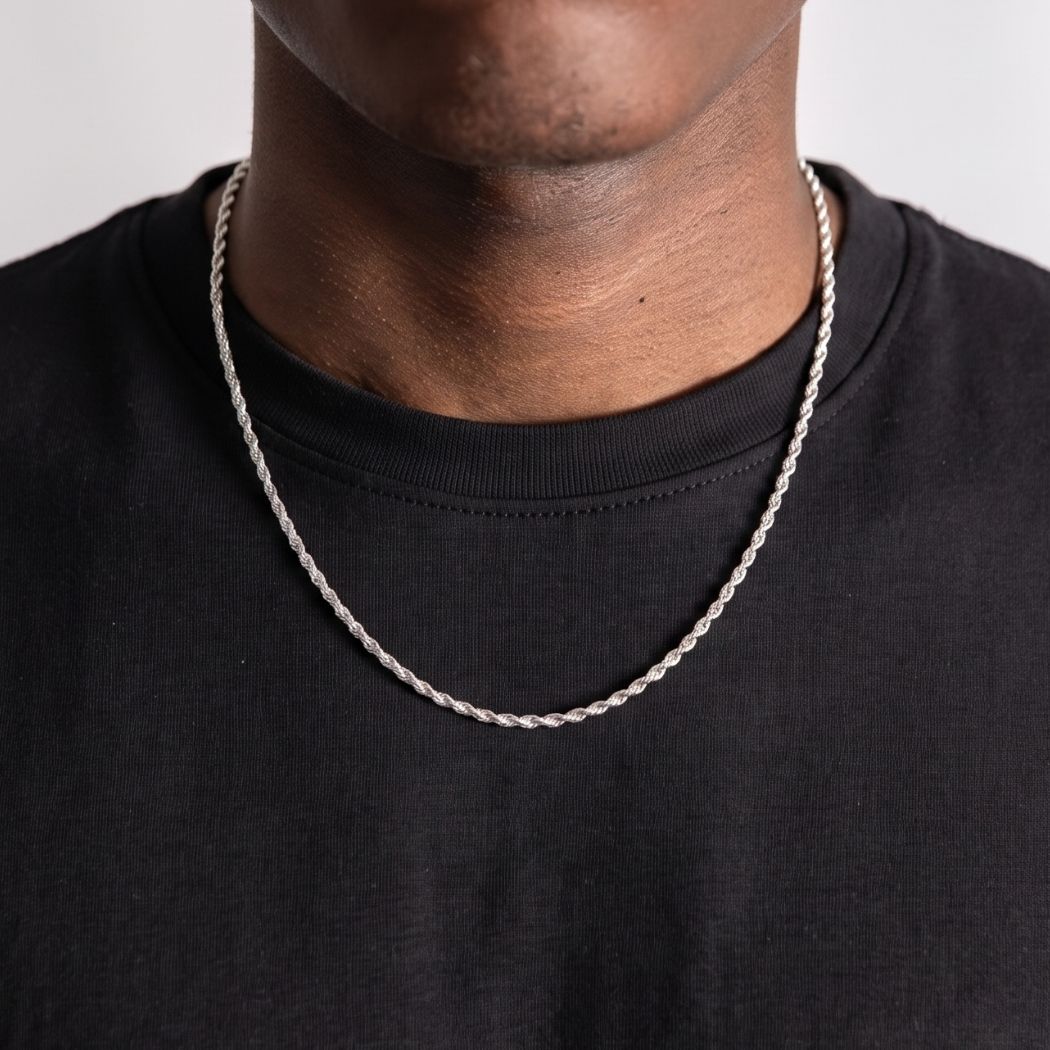
The right width is between 2 and 3 mm. Below 2 mm the strand looks like a line and the pendant dominates; above 3 mm the chain starts competing with the clover shape and you see two pieces instead of one. Concretely: the silver box chain in 2 or 3 mm is the most neutral choice, the 2 mm rope chain in solid 925 silver matches the metal of the pendant exactly, the 3 mm franco fox tail is the most tightly woven and therefore the sturdiest, and the 2.5 mm king's link in 925 silver sits precisely in between.
4. And the length: 45, 50 or 55 cm (18, 20 or 22in)
With a pendant, length counts differently, because you are not looking at the end of the strand but at the point where the clover hangs. With a neck circumference of 40 cm (15.7in), a 50 cm (20in) chain falls about 5 cm (2in) below your neckline, and the 3.8 cm (1.5in) of the pendant itself comes on top of that. On 50 cm (20in) the pendant therefore falls like a bare chain of about 58 cm (23in).
At 45 cm (18in) it falls just below the collarbone, above the first button of a shirt. At 50 cm (20in) it lands just below the top of the breastbone, and that is the length that fits this size most often. At 55 cm (22in) it drops to mid chest.
Note that not every family runs the same series. Box comes in 45, 50 and 55 cm (18in, 20in and 22in), rope in 925 silver and the king's link in 50, 55 and 60 cm (20in, 22in and 24in), and the franco fox tail only in 50 and 60 cm (20 and 24in). How a length falls is worked out in which length box chain fits you best.

5. VVS against 5A: two gradings in one line
Here is a detail almost nobody explains. The pendant carries cubic zirconia marked VVS, while the clover bracelet from the same line carries cubic zirconia marked 5A. Those are not two names for the same thing: they are two different scales.
VVS comes from clarity grading and stands for very very slightly included. It says exactly one thing: how clean the stone is inside. Inclusions are barely findable even under a loupe. About color and cut it says nothing.
5A is not a scientific standard but a trade sorting scale running from A through AAA to 5A, with 5A as the top step. That single mark covers three things at once: how colorless the stone is, how clean it is inside, and how precisely the facets are cut.
Why that difference makes sense shows in how you wear the two. A clover bracelet is a continuous row of links around your wrist, constantly moving. There it matters whether every stone is set at the same angle, because one stone slightly off catches light differently from its neighbors. A pendant hangs still at chest height and gets looked at from close up. There what counts is what sits inside the stone, and that is exactly what VVS records. The bracelet is judged on the row, the pendant on the stone.

6. On the wrist rather than the neck
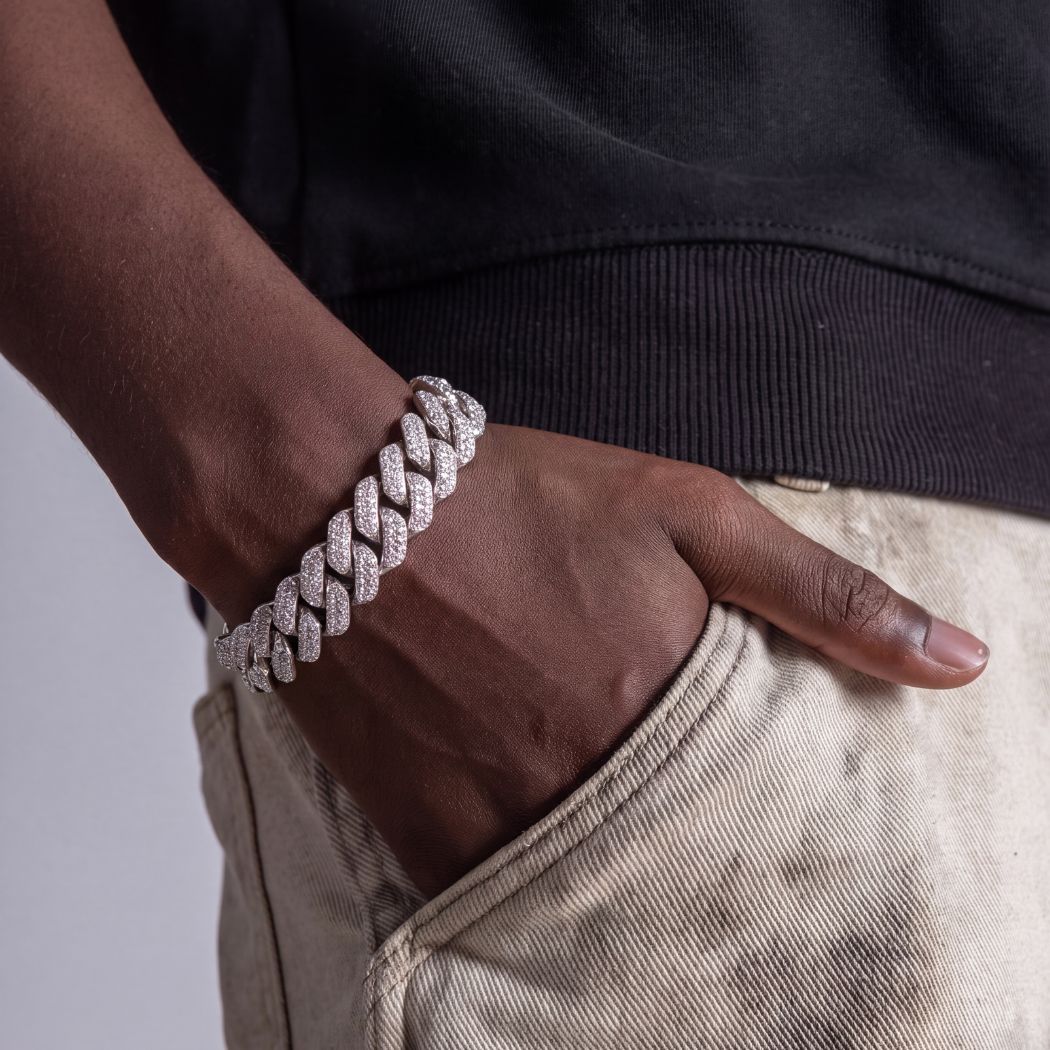
If you want the clover shape but would rather keep your neck free, there is the bracelet. Two versions sit side by side: a silver one with faceted cubic zirconia in 18 and 21 cm (7.1 and 8.3in), and a gold-colored one with an opaque, matte black clover on stainless steel in 19 and 22 cm (7.5 and 8.7in). The first throws light back, the second swallows it.
That difference decides when you wear which and how you clean them. It is worked out in full in clover bracelet: black or iced out cubic zirconia, including the size series that do not line up.
If you combine pendant and bracelet, follow one rule: let the clover be the only set shape. Two fully set pieces catch the same light and flatten each other out.

7. Care: 925 silver with cubic zirconia
This is bare 925 silver with no coating, and silver can tarnish over time: first yellow, then brown, then dark. That is not wear. Rub the metal back up with a silver cloth and leave the stones alone while you do.
If the stones look dull, that is almost never wear but grease. Hand cream and soap collect under the setting, and that is exactly where the light enters. Lukewarm water, a drop of mild soap and a soft toothbrush along the underside of the settings will clear it. Dry thoroughly afterwards.
What you do not do: an ultrasonic bath, abrasives or silver polish with a cutting action. An ultrasonic bath can shake stones loose and abrasives take silver away. Take the pendant off for the pool, because chlorine damages silver permanently. Keep this order as well: perfume, deodorant and cream first, let them dry, then put the pendant on. You will find more on the same base in 925 sterling silver jewelry.
Four mistakes you spot immediately
- Assuming a chain is included. The 2.1 by 3.8 cm pendant ships on its own. Add the strand right away.
- Hanging it on a flat link. Cuban, figaro and jubilee rotate under the pull and the clover ends up at an angle.
- Choosing too wide. Above 3 mm you see two pieces of jewelry instead of one. Between 2 and 3 mm it works.
- Polishing with an abrasive. An abrasive takes silver away. Lukewarm water, mild soap and a soft cloth are enough, and a silver cloth wipes away tarnish.
Where do you start?
If you already own a round chain of 2 or 3 mm, the clover pendant silver iced out is the only thing you still need. Starting fresh, take it with a 2 mm box chain on 50 cm (20in): at this size that combination hangs the way it was meant to most often.
To look wider, the lucky clover jewelry collection lines up everything with the four leaves, from pendant to bracelet, in silver and in gold color.
Frequently asked questions
Does a chain come with the clover pendant?
No. The clover pendant silver iced out ships on its own, without a chain, in a Carpe Ice jewelry box. You choose the chain separately, to suit the pendant of 2.1 by 3.8 cm.
How big is the clover pendant exactly?
It measures 2.1 cm wide by 3.8 cm tall, with that height counting the bail for the chain. The clover leaf itself takes up roughly the bottom two centimeters.
Which chain width suits a pendant of 2.1 by 3.8 cm?
Between 2 and 3 mm, and then a round strand: box, rope, franco or king's link. Below 2 mm the pendant dominates the picture, above 3 mm the chain starts competing with the clover shape.
Why should a flat link not go under a pendant?
Because a pendant pulls on a single point and a flat link rotates around its own axis under that pull. Cuban, figaro and jubilee tip as a result and the clover ends up hanging at an angle.
What is the difference between VVS and 5A cubic zirconia?
VVS comes from clarity grading and says only how clean the stone is inside. 5A is a trade sorting scale from A through AAA to 5A that covers colorlessness, clarity and cut at once. The pendant carries VVS, the clover bracelet 5A.
How do you clean 925 silver with cubic zirconia?
With lukewarm water, a drop of mild soap and a soft toothbrush along the underside of the settings, because that is where the grease that kills the sparkle sits. If the silver darkens, rub it back up with a silver cloth. No ultrasonic bath or abrasives.

