


Article: Rope chain: why the same braid exists in three tiers
Rope chain: why the same braid exists in three tiers
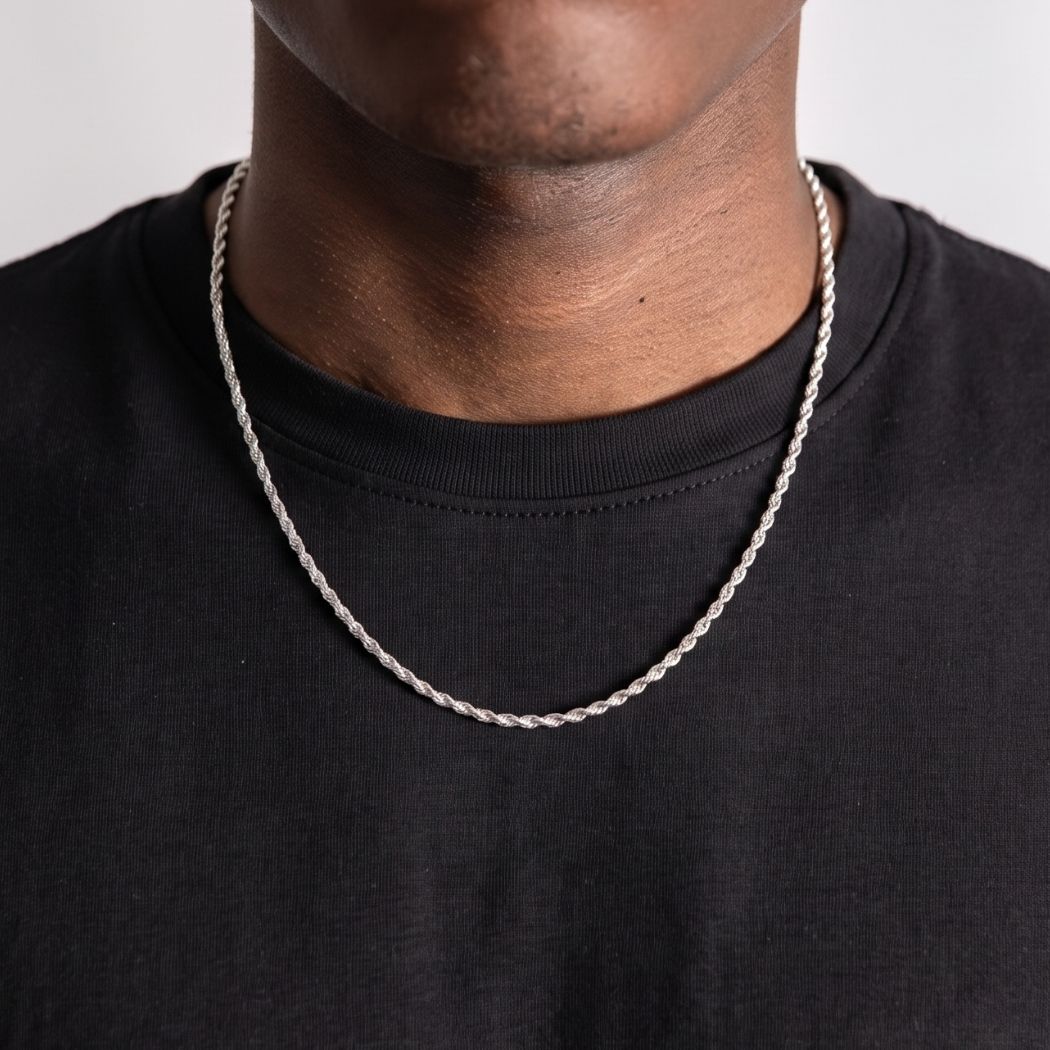
A rope is not a row of separate links but a braid: strands twisted around one another into a continuous spiral. We carry that braid in three builds and six widths, and they all look the same.
The question is what sits underneath. With stainless steel you pay for the work and, in gold color, for the five layers of PVD. With solid 925 sterling silver you pay for the metal itself. With 18K gold plated you pay for two metals at once: a gold layer and a silver core. That is the whole ladder, explained without naming a single amount.

1. What a rope link is, and why it flickers
On a flat link every face lies in the same direction. A cuban or a figaro therefore reflects like one surface: it catches the light or it does not. On a rope every turn sits slightly rotated relative to its neighbor, so at any moment the chain has faces at dozens of different angles at once.
You see the result the moment you move: somewhere a facet is always angled exactly right, and which one that is keeps changing. A flat chain shines, a rope flickers. That is also why a rope looks calmer in a photo than in real life, because a photo freezes exactly one position.
2. The same braid, three builds
Stainless steel, bare or with five layers of PVD. The silver-colored rope chain and the gold-colored rope chain both run in 2 mm and 3 mm, with four lengths: 45, 50, 55 and 60 cm (17.7, 19.7, 21.7 and 23.6 inches). The silver-colored version is polished steel with no coating. On the gold-colored version the color is bonded to the steel at molecular level in a vacuum chamber instead of being electroplated. Here you are paying for the work, not the metal.
Solid 925 sterling silver. There is no layer here. The 2 mm, the 3 mm and the 4 mm are the metal itself, all the way through, in 50, 55 and 60 cm (19.7, 21.7 and 23.6 inches). Here you are paying for material, which is why width counts hardest in this line.
18K gold plated over 925 silver. The 1.5 mm, the 2.8 mm and the 3.8 mm are two metals on top of each other: a gold layer of 2.5 microns over a core of solid sterling silver, in 50, 55 and 60 cm (19.7, 21.7 and 23.6 inches). What those 2.5 microns mean is set out in the guide on which 18K gold plated rope chain suits you.
All three builds close with a lobster clasp and arrive in a Carpe Ice jewelry box.

3. Why width counts harder on a rope
Material grows with the square of the width. Going from 2 mm to 4 mm doubles the width but makes the cross section four times as large. Between 1.5 mm and 4 mm there is a factor of more than seven, while in millimeters it does not even look like three times as much.
On a rope something else is added on top. The strands run diagonally, so over the same chain they travel a longer path than the chain is long. Twisting costs material, and that difference multiplies with the same quadratic jump.
That is why a step from 3 mm to 4 mm feels bigger on a rope than you would expect from one millimeter: in weight, in how stiffly the chain falls and in what it costs. On solid 925 that works through most directly, because there every extra millimeter really is extra precious metal.

4. The six widths and where they land
The rope line counts six widths: 1.5 / 2 / 2.8 / 3 / 3.8 and 4 mm. Put in order, what stands out is that the plated line and the silver line never overlap: 1.5 mm sits below the 2 mm, 2.8 mm between 2 and 3 mm, and 3.8 mm between 3 and 4 mm.
The 1.5 mm is the finest strand and works as a pendant chain or as a bottom layer. The 2 mm is the quiet solo option, the 2.8 mm the middle size where the chain itself gets seen. The 3 mm is the only width that also exists as a bracelet, the 3.8 mm the heaviest plated one and the 4 mm the widest rope, in solid silver only.
If you are hesitating between two widths that sit next to each other, do not choose from a product photo. Every photo is enlarged and the difference between 2.8 and 3 mm is zero on a screen.
5. What wears first, per build
On a rope the wear always sits in the same place: on the raised ridges of the spiral, which rub along your collar. What happens there differs per build.
On stainless steel with PVD, the gold-colored version, the color is a finish. If it wears off the ridges, steel appears: no rust and no green residue, only a difference in color. The PVD bond is harder than an ordinary electroplated layer, and on a link with many friction points that is exactly what you want. The silver-colored steel is bare and has no finish to lose.
On solid 925 there is no layer to lose. What does happen is tarnish: silver reacts with sulfur in the air and goes darker, which a silver cloth reverses. Silver is softer than steel, though, so the ridges become slightly rounder over the years, and a rope that has rounded off flickers less sharply.
On 18K gold plated the gold layer wears on those same ridges, and what lies underneath is sterling silver rather than a base metal. That is why having it replated is worth it here. More on that in the article on 18K gold plated chains.
6. The bracelet exists only in steel, and that makes sense
The silver-colored rope bracelet and the gold-colored rope bracelet are both 3 mm and run in 16, 18, 20 and 22 cm (6.3, 7.1, 7.9 and 8.7 inches). They exist only in stainless steel; we carry no rope bracelet in solid silver or plated.
That is not a gap but a consequence. A wrist hits table edges, sleeves and a keyboard all day; a neck hits nothing. The softest build rounds off there fastest and the thinnest layer wears through there fastest. Steel is the hardest base, and that is what is left standing on a wrist.
Note the sizing too: the chains in steel start at 45 cm (17.7 inches), while the silver and the plated ones only begin at 50 cm (19.7 inches). If you deliberately want a short chain, that is a reason to look at steel. If you are unsure about length, the chain size chart helps.

7. Care: the grooves are the point
Every rope has one drawback compared with a smooth chain: there are grooves between the turns, and soap stays in them. So rinse for longer than you are used to and pat it dry. Soap residue is the most common reason a rope looks dull when nothing is wrong with it.
The rest differs per build, and on steel even per color. The silver-colored steel, which is bare, does not have to come off for washing your hands, rain or the shower, only for the pool. The gold-colored one you take off before the pool, the shower and the gym, and put back on once perfume or aftershave has dried. Same link, same steel, different advice.
For solid 925, lukewarm water, a drop of mild soap and drying thoroughly is enough, with a silver cloth as soon as it tarnishes. For the plated line it is lukewarm water, mild soap and a soft cloth. No silver polish and no ultrasonic bath on a finish: those are meant for solid metal.

Four mistakes you spot right away
- Looking for a width this link does not have. The rope line runs up to 4 mm and stops there. If you want more volume, you are looking for a different link family.
- Choosing from a product photo. Every photo is enlarged and the six widths sit close together. Millimeters are compared with a ruler.
- Silver polish or an ultrasonic bath on a finish. On solid silver that is fine; on PVD and on plating you remove the very layer you want to keep.
- Assuming gold color and silver color need the same care. On steel they do not: the silver-colored one can come into the shower, the gold-colored one cannot.
Where do you start?
If you want a chain that can go on every day without thinking about it, the silver-colored rope chain in steel at 3 mm is the most carefree choice, with the matching bracelet alongside it.
If you want precious metal without a layer that can wear, you start with the rope chain in 925 sterling silver, where the 4 mm is the point at which the weight becomes genuinely noticeable. You will find the rest in the 925 sterling silver jewelry.
If you want gold color that is not only color, the 2.8 mm in 18K gold plated is the middle size. The full rope collection puts all eight chains and both bracelets side by side.
Frequently asked questions
Which rope chain widths does Carpe Ice carry?
Six: 1.5 / 2 / 2.8 / 3 / 3.8 and 4 mm. The 1.5 mm, 2.8 mm and 3.8 mm are 18K gold plated, the 2 mm and 3 mm exist in stainless steel and in solid 925 silver, and the 4 mm in 925 silver only.
What is the widest rope chain there is?
4 mm, in solid 925 sterling silver, in 50, 55 and 60 cm (19.7, 21.7 and 23.6 inches). We do not carry this link above that. If you want more volume, you end up with a different link family.
What is the difference between the steel, the silver and the plated rope?
The braid is the same, the base is not. Stainless steel is a working metal, bare in silver color and with a hard five-layer PVD finish in gold color. Solid 925 is precious metal without a layer. 18K gold plated is a gold layer of 2.5 microns on a core of 925 silver, so two metals at once.
Why does a rope weigh more than another chain of the same width?
Because the strands run diagonally around one another and therefore travel a longer path than the chain is long. Twisting costs material, so at equal width a rope holds more metal than a flat link.
Is there a rope bracelet in silver or in gold plated?
No. The rope bracelet exists only in stainless steel, 3 mm, in gold color (with PVD) and silver color (bare steel), in 16, 18, 20 and 22 cm (6.3, 7.1, 7.9 and 8.7 inches). A wrist takes far more knocks than a neck, and steel is the hardest of the three bases.
How do I clean a rope chain?
Lukewarm water, a drop of mild soap and a thorough rinse, because more soap stays behind in the grooves than on a smooth chain. Pat it dry afterwards. Do not use an ultrasonic bath or silver polish on a finish.

