


Chain Length Guide: Where 45 to 75 cm (18 to 30in) Actually Falls
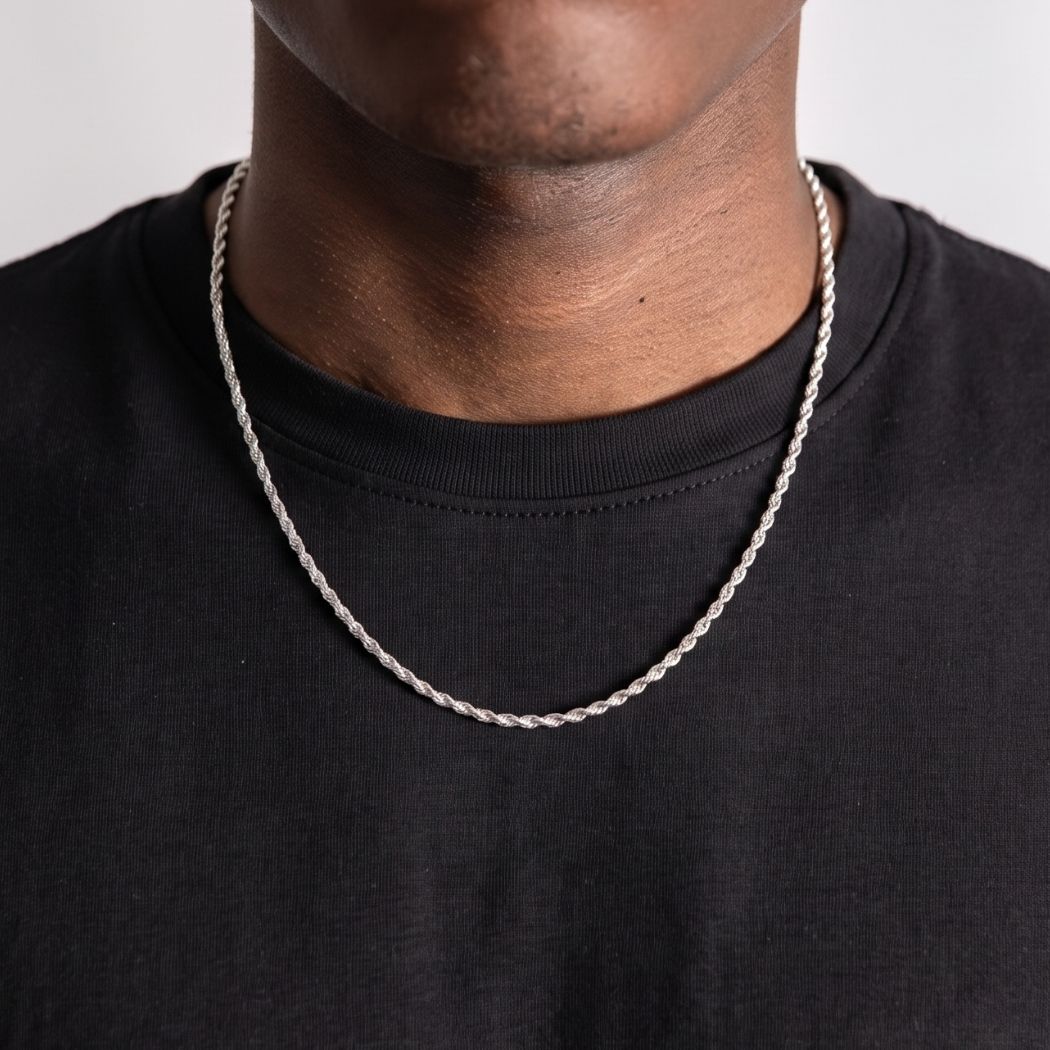
There are five centimeters between a 50 cm (20in) and a 55 cm (22in) chain. On your body that is two and a half, and that is exactly the difference between a chain that disappears under your collar and one that stays just above it.
You can pick a width off a photo. Length you cannot, because half of what you add disappears into the arithmetic. This article covers where each length falls, what our customers actually pick, and why a 4 cm pendant counts for more than 4 cm of extra chain.

1. What people actually choose
These are our own sales figures over the past twelve months, across all necklaces. Not an estimate and not an industry average.
| Length | Share of all chains sold | Roughly where it falls |
|---|---|---|
| 45 cm (18in) | 3% | Tight at the neck |
| 50 cm (20in) | 25% | Just below the collarbone |
| 55 cm (22in) | 34% | Top of the breastbone |
| 60 cm (24in) | 20% | Mid chest |
| 65 cm (26in) | 11% | Below the chest |
| 75 cm (30in) | 9% | Down to the stomach |
78% of everything we sell sits between 50 and 60 cm (20 and 24in), and 55 cm (22in) on its own accounts for a third. If you do not want to think about it and you are averagely built, 55 cm (22in) is the safe pick.
The 20% at 65 and 75 cm (26 and 30in) needs a caveat, because those figures come almost entirely from one product. The 5 mm king's link chain is the only chain we carry in 75 cm (30in), and on that single product 44% of sales go to 65 or 75 cm (26 or 30in). So the demand for long is real. It is just capped by what there is to choose from.
2. The rule behind every length
A chain is a closed loop. Whatever is longer than your neck hangs down, and it does that over two sides at once. That gives you the only rule of thumb you need:
Drop below your neckline = (chain length minus neck circumference) divided by 2.
Measure your neck with a piece of string at the height where you want the chain to sit. At a neck of 40 cm (16in), a usable starting point for adult men, that works out as:
- 45 cm (18in) of chain gives a 2.5 cm drop
- 50 cm (20in) gives 5 cm
- 55 cm (22in) gives 7.5 cm
- 60 cm (24in) gives 10 cm (4in)
- 65 cm (26in) gives 12.5 cm
- 75 cm (30in) gives 17.5 cm (6.9in)
It is an approximation, because a chain drapes and does not leave your neck at a single point. But it holds to within about a centimeter, and that is more accurate than any photo.
3. Eight centimeters more chain is four centimeters lower
That division by two is why people misjudge their size. Go from 55 to 60 cm (22 to 24in) and you buy 5 cm of chain and gain 2.5 cm of height. Go from 55 to 65 cm (22 to 26in) and it sounds like a big jump, but you drop 5 cm.
Two things follow from that. If you are torn between two consecutive lengths, the difference is smaller than you think, so take the shorter one. And if you genuinely want a different look, you have to move two steps up, not one. That is exactly why the king's link in 5 mm runs in 50, 55, 65 and 75 cm (20, 22, 26 and 30in) rather than in even steps of five.
Our chain size chart shows what that looks like on a model. Use the photo to check yourself, and the rule above to order.
4. A pendant counts in full
This is where it goes wrong most often. Extra chain length spreads over two sides, but a pendant hangs from the lowest point and therefore counts for its whole height.
A 4 cm pendant drops your chain 4 cm further. To get that same effect from chain length you would need 8 cm more. A pendant has twice the effect of the same length in chain.
So work it in before you order. Our plain 3 cm cross on a 50 cm (20in) chain falls like a bare chain of 56 cm (22in), and the iced out cross pendant of 4.1 cm falls on 50 cm (20in) like 58.2 cm (23in). On our cross necklace with blue stones of 6.5 mm and the cross necklace with colored stones of 15 mm you add nothing: there the cross is part of the chain itself, not a pendant. We supply those short, in 45 and 50 cm (18 and 20in), because a stone-set band belongs high, where it reads as a collar. How to pick the length for a loose cross pendant is in our men's cross necklace guide.

5. Width and length belong together
A narrow chain can be short. A wide one cannot, because it needs room to look like one surface instead of a band around your neck.
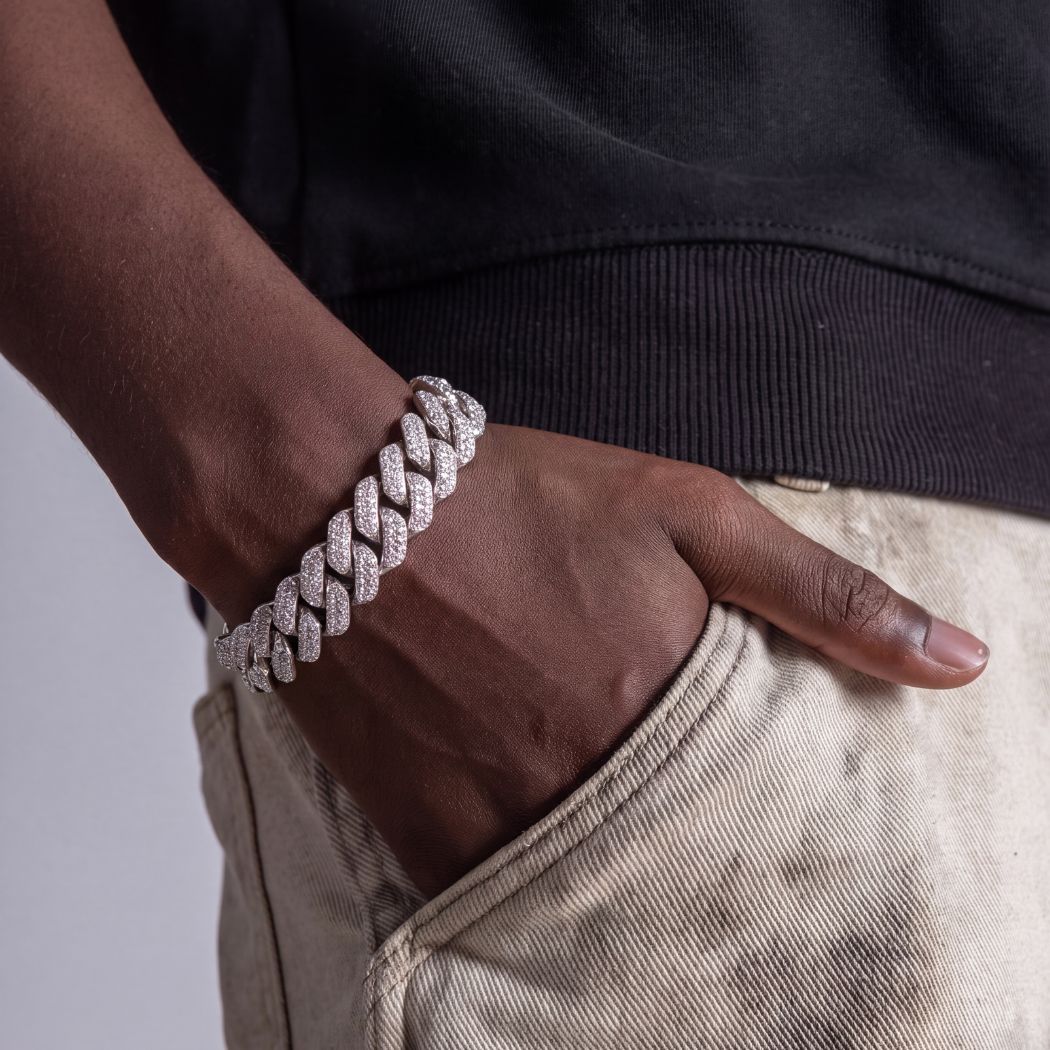
We can see that in the figures for a single product. Our iced out cuban chain comes in 6, 8 and 10 mm, each in 50, 55 and 60 cm (20, 22 and 24in). At 6 mm the best selling length is 50 cm (20in). At 10 mm it is 60 cm (24in). Same product, same kind of buyer, and still the chosen length moves up a step as soon as the link gets wider.
The explanation is geometry, not taste: the wider the link, the higher it sits on your chest instead of following its shape. That costs height, and you buy that height back with length. It is why the 2 mm box chain starts at 45 cm (18in) and the iced out does not. What else sets a 10 mm chain apart is in our guide on what iced out means.

6. Not every link exists in every length
This is the dull constraint most size guides step over. You can only choose a length once the link you want actually has it.
| Link | Lengths available | What that means |
|---|---|---|
| Box, 2 and 3 mm | 45, 50, 55 cm (18, 20, 22in) | Stops at 55, built as a base under a pendant |
| Cross with stones | 45, 50 cm (18, 20in) | Short: the cross sits in the chain itself and a stone-set band belongs high |
| Franco, 3 mm | 50 and 60 cm (20 and 24in) | Skips 55, so pick short or long on purpose |
| Rope, 2 and 3 mm | 45 to 60 cm (18 to 24in) | The full band, including the short end |
| Cuban, tennis, iced out | 50, 55, 60 cm (20, 22, 24in) | No 45, too wide for that length |
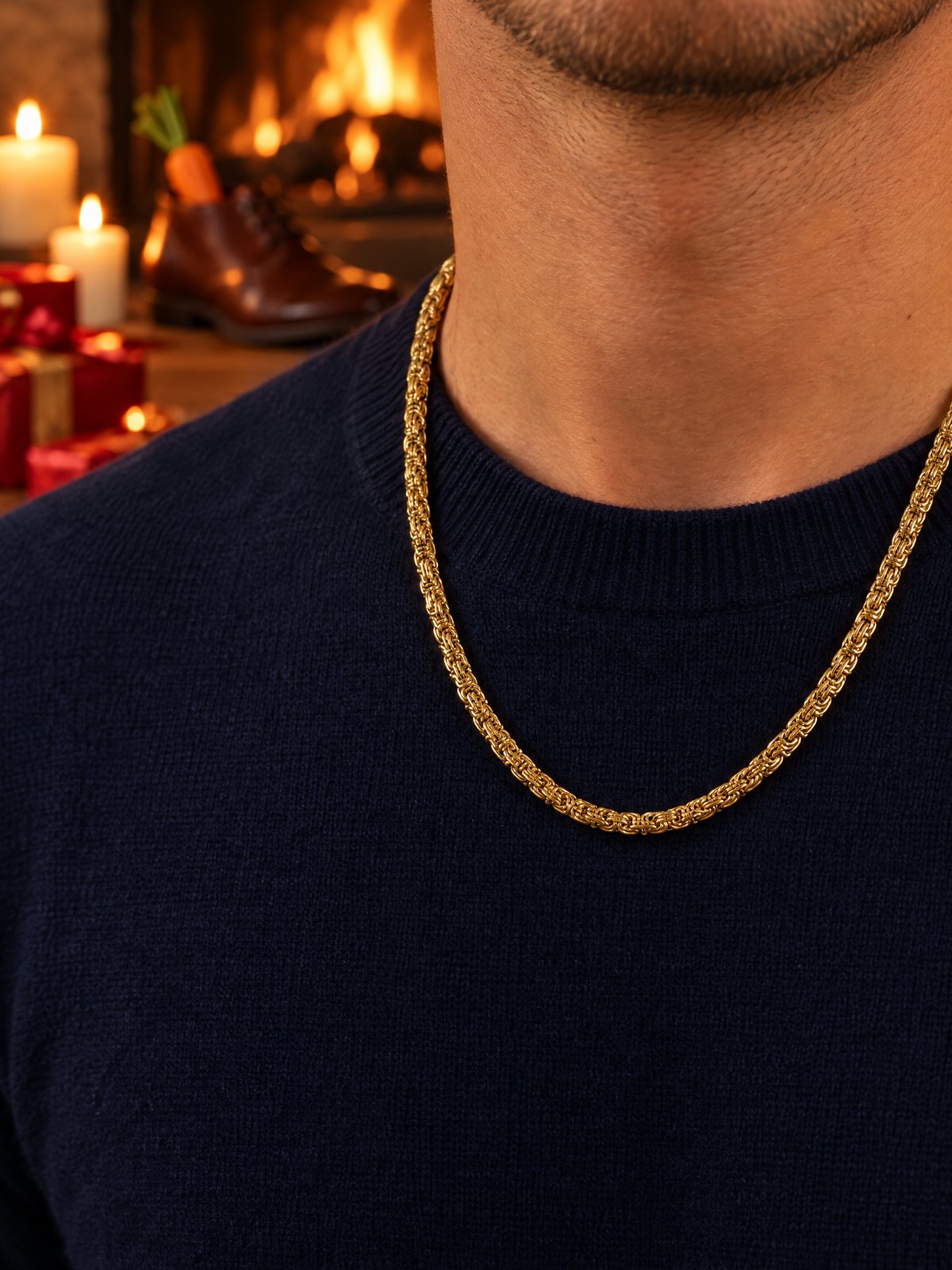
| King's link, 5 mm | 50, 55, 65, 75 cm (20, 22, 26, 30in) | The only one that goes past 60 |
| King's link, 2.5 mm | 50, 55, 60 cm (20, 22, 24in) | Fine enough to stay under a collar |
If you want 75 cm (30in) you end up at the king's link. If you want 45 cm (18in), look at box, rope or a cross necklace.

7. Two chains at once: at least 10 cm apart
Layering goes wrong in almost exactly the same way every time. People pick two lengths that sit too close together, after which the chains cross each other all day and end up twisted.
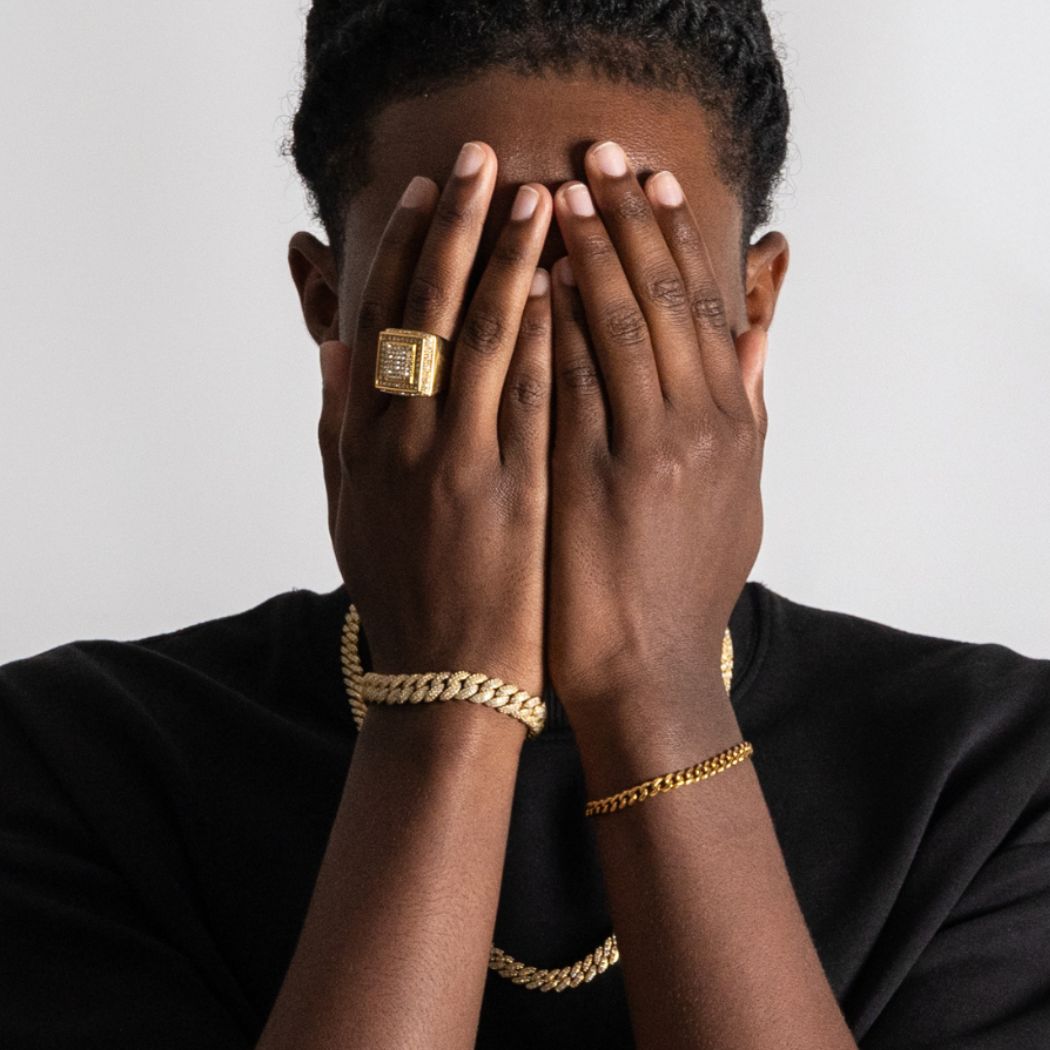
Keep at least 10 cm of difference in length and a visible difference in width, with the longer chain being the wider one. So 50 and 60 cm (20 and 24in), or 55 and 65 cm (22 and 26in). Translated into the rule above: 10 cm of chain is 5 cm of space between the two, and any less than that does not survive you moving around.
Start with two. Add the third only once the first two hang right on their own. More on how that looks this year is in our men's jewelry trends for 2027.

8. Measuring without a tape measure
You do not need a tape measure, and you do not need a chain you already own. A shoelace or a charging cable works just as well.
- Put a piece of string around your neck at the height where you want the chain, and pinch the point where the ends meet. That is your neck circumference.
- Decide how far down you want it to sit. Look in the mirror and hold a finger at that spot.
- Multiply that drop by 2 and add your neck circumference. That is your chain length.
- Round to the nearest length the link actually has, and round down if you land in between.
If you do own a chain that hangs well, it is quicker: lay it closed and straight on a table and measure the whole loop. That number is the length you order, whichever link it is.
Where do you start?
First chain and no idea? 55 cm (22in) in a width between 3 and 5 mm. That is a third of our sales, it falls on your breastbone and it fits under a shirt. The 4 mm cuban chain in 925 sterling silver and the wider end of the 925 sterling silver jewelry both work for that.
Want to wear it over a T-shirt instead of under one? Then 60 cm (24in), or 65 cm (26in) if you are broader built. For those lengths you are looking at the king's link.
Going to wear a pendant? Take the 3 mm rope chain or a box chain in 45 or 50 cm (18 or 20in), and add the height of the pendant. And if you pick solid silver, read how to keep it clean in our guide on how to clean silver jewelry. The rest of the range is under jewelry for him.
Frequently asked questions
Which chain length is chosen most?
55 cm, or 22 inches. That length accounts for 34% of every chain we sold over the past year, and together with 50 and 60 cm (20 and 24in) it covers 78% of sales. At a neck circumference of 40 cm (16in), 55 cm (22in) falls about 7.5 cm below your neckline, so on the top of your breastbone.
How do I calculate the chain length I need?
Subtract your neck circumference from the chain length and divide the difference by 2. That is how far the chain hangs below your neckline. At a 40 cm (16in) neck, a 50 cm (20in) chain gives a 5 cm drop, 55 cm (22in) gives 7.5 cm and 60 cm (24in) gives 10 cm. Measure your neck with a piece of string at the height where the chain should sit.
Why does 5 cm of extra chain feel like almost nothing?
Because a chain is a closed loop and the extra length spreads over two sides. Five centimeters of extra chain gives 2.5 cm of extra drop, and 8 cm gives 4 cm. If you want to sit visibly lower, you have to move two length steps up rather than one.
Does a pendant count toward chain length?
Yes, and in full. A pendant hangs from the lowest point of the loop and so counts for its entire height, while chain length gets halved. A 4 cm pendant does the same thing as 8 cm of extra chain. Work it in before you choose the length.
Which length should I pick for a wide chain?
One step longer than for a narrow one. On our iced out cuban chain, which comes in 6, 8 and 10 mm, the best selling length is 50 cm (20in) at 6 mm and 60 cm (24in) at 10 mm. A wide link sits higher on your chest instead of following its shape, and you buy that height back with length.
How much difference should there be between two chains?
At least 10 cm in length and a visible difference in width, with the longer chain being the wider one. So 50 and 60 cm (20 and 24in), or 55 and 65 cm (22 and 26in). Ten centimeters of length difference gives 5 cm of space between the two chains, and any less does not hold once you move.

%20and%20a%2055%20cm%20(22in)%20chain.%20On%20your%20body%20that%20is%20two%20and%20a%20half,%20and%20that%20is%20exactly%20the%20difference%20between%20a%20chain%20that%20disappears%20under%20your%20...)