
Item: Eight kinds of bracelet, and what they are really made of
Eight kinds of bracelet, and what they are really made of
Eight bracelet families, four ways of building them. That is the whole collection.
What almost always goes wrong is the material. Silver-tone is not the same as silver, gold-tone is not the same as gold, and a stone that sparkles is not a diamond. This guide says three things per family: what it is, which widths and sizes exist, and what it is made of.

1. The four builds
Stainless steel with five layers of PVD. The color is bonded to the steel at molecular level in a vacuum chamber instead of being applied by electroplating. This is the most durable build in the store: washing your hands, rain and the shower are no problem. It sits under cuban, rope, figaro, jubilee, byzantine and the king's link bracelet of 5 mm.
Nickel-free copper alloy with five layers of PVD. The same technique on a softer base. Everything iced out and the tennis line with cubic zirconia stand on this. The alloy underneath is more sensitive to moisture than steel, so these pieces stay home when you go to the gym.
Solid 925 sterling silver. 92.5% pure silver with copper for strength. No layer that can wear through, because what you see is the metal itself. Silver is softer, so you pick up fine marks sooner here, and it can darken over time.
18K gold plate over 925 silver. A layer of 1 micron of 18K gold over that same silver core. Warmer and deeper in color than gold-tone PVD, and the clasp is where that layer takes the most punishment.
2. Cuban: one shape, three materials
The flat, interlocked link that reads as a single continuous line across your wrist. We carry it in three versions, and those are three different materials.
The cuban bracelet in stainless steel comes in 3, 5 and 7 mm, in gold tone and silver tone, and in 18, 20 and 22 cm. The base is stainless steel with five layers of PVD, without stones.
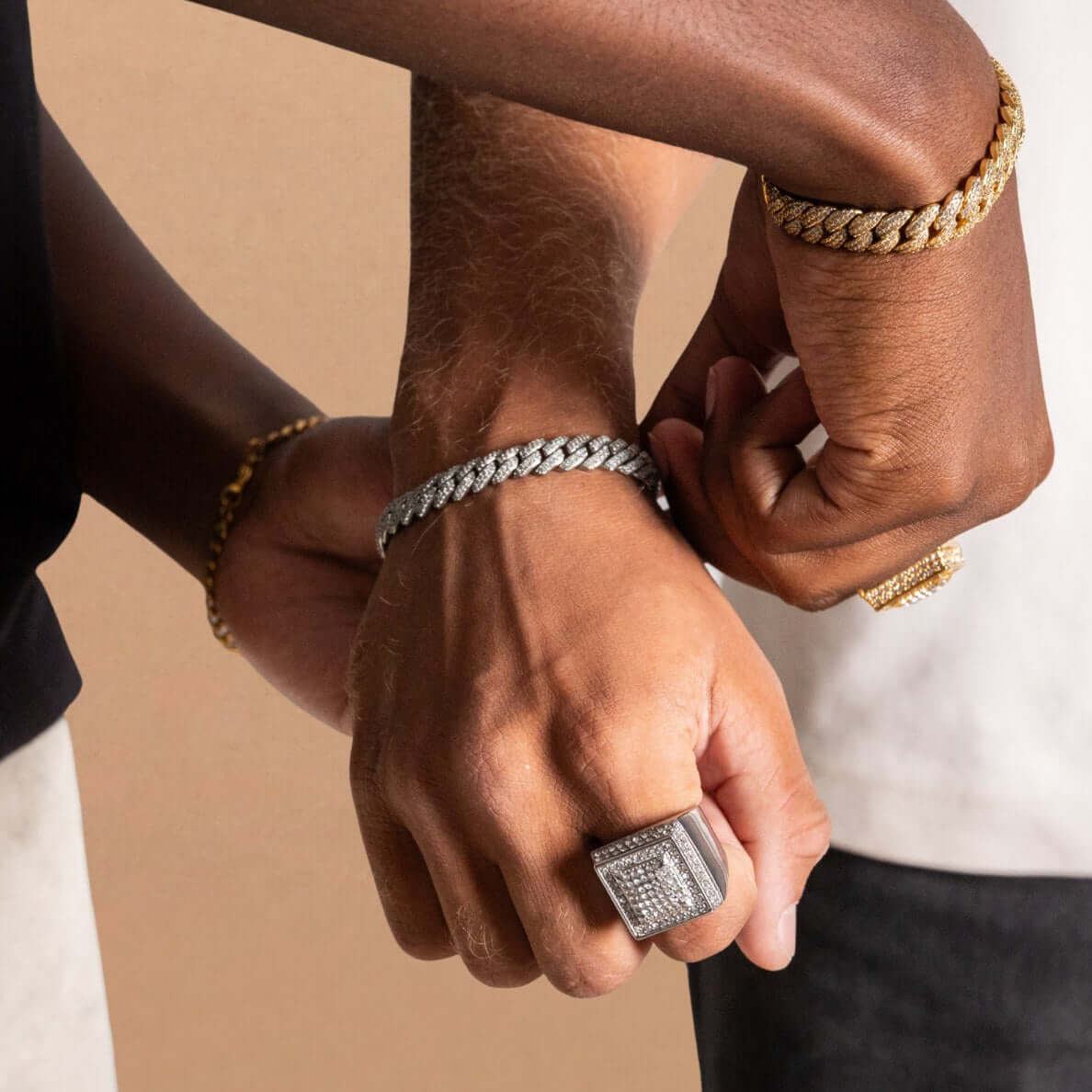
The iced out cuban bracelet is 6, 8 or 10 mm and runs in 18, 20 and 22 cm. It stands on a nickel-free copper alloy with five layers of PVD and is set with VVS cubic zirconia, a simulated diamond.
The cuban bracelet in 18K gold plate is 5 mm in 18, 20 and 22 cm. Under the 1 micron gold layer sits solid 925 sterling silver. This is the only cuban bracelet with a precious metal core.

3. Tennis and cluster: what the stones stand on
A tennis bracelet is a continuous row of stones of equal size. The difference between the three versions is in the stone and in the base.
The tennis bracelet of 3 and 5 mm has one row of VVS cubic zirconia on a nickel-free copper alloy with five layers of PVD, in gold tone and silver tone, in 18 and 20 cm.
The tennis cluster bracelet of 10 and 12 mm uses the same copper alloy with five layers of PVD and the same VVS cubic zirconia, but sets the stones in several rows side by side. It comes in 18 and 21 cm.
The moissanite tennis bracelet of 5 mm is the only one in this group on solid 925 sterling silver, in 18 and 20 cm. The stones are VVS D moissanite, silicon carbide and a gemstone in its own right, not the same as cubic zirconia and not the same as diamond. None of these stones holds value: on the moissanite version the silver is the only part with material value.
4. King's link and byzantine
Dense, round links that look the same from every side. They stand out through thickness rather than width.
The king's link bracelet of 5 mm is stainless steel with five layers of PVD, in gold tone and silver tone, in 18, 20 and 22 cm. This is the version that goes everywhere with you.
The king's link bracelet of 2.5 mm is solid 925 sterling silver with no layer around it, in 18, 20 and 22 cm. The same link also exists in 18K gold plate: exactly the same 2.5 mm and the same sizes, with one micron of 18K gold over the silver core.
The byzantine king's bracelet of 6 mm weaves the links into a block, which makes it look wider. Stainless steel with five layers of PVD, in gold tone and silver tone, in 18, 20 and 22 cm.

5. Rope, figaro and jubilee
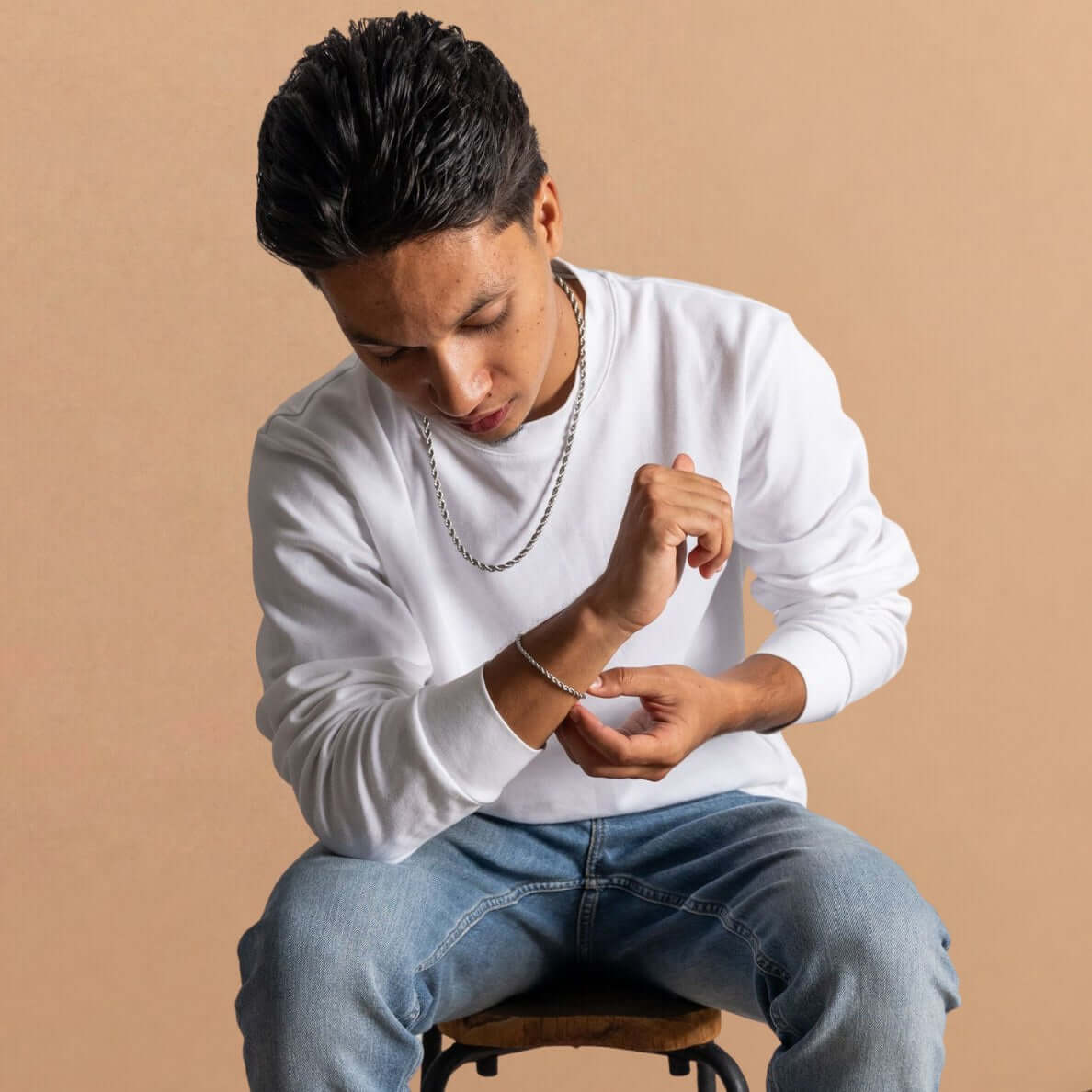
The rope bracelet of 3 mm has links that spiral around each other, which is why it flickers as you move. Stainless steel with five layers of PVD, in gold tone and silver tone, in 16, 18, 20 and 22 cm.
The figaro bracelet of 3 and 5 mm has a fixed rhythm of short and long links, which makes it quieter than a cuban of the same width. Stainless steel with five layers of PVD, in gold tone and silver tone, in 16, 18 and 20 cm.
The jubilee bracelet of 10 mm is built from rows of small links and reads as a watch strap without the watch. Stainless steel with five layers of PVD, in gold tone, rose gold tone and silver tone, in 18, 20 and 22 cm.

6. Iced out one-offs
Four bracelets where a shape plays the lead and the stones fill that shape in.
The honeycomb bracelet of 7 mm sets hexagonal panels side by side, with VVS cubic zirconia on a nickel-free copper alloy with five layers of PVD, in gold tone and silver tone, in 17 and 20 cm.
The clover bracelet is the only iced out bracelet with a precious metal core: solid 925 sterling silver with a silver-tone PVD finish and 5A cubic zirconia, in 18 and 21 cm.
The emerald bracelet of 7 mm alternates clear and emerald green VVS cubic zirconia, with a hidden safety clasp, in 18 and 21 cm. The cross bracelet with colored stones of 15 mm stands on the same copper alloy with five layers of PVD, in 18 and 20 cm.

7. Which size you need
The size on the label is the total length of the band, clasp included, not your wrist circumference. Measure your wrist and add about 1.5 cm. Under 17 cm of wrist circumference you land on 18 cm, between 17 and 20 cm on 20 cm, and above 20 cm on 22 cm.
Not every family exists in every size. Rope and figaro start at 16 cm, cluster and clover run in 18 and 21 cm, and honeycomb in 17 and 20 cm.
The full table is on the bracelet size chart. Which width suits your wrist, and how to measure without a tape measure, is covered in the bracelet sizing guide.
8. Links tight, stones loose
A link bracelet may sit tight. Cuban, rope, figaro, jubilee, king's link and byzantine are built from links that move over each other, so the band follows your wrist. If you fall between two sizes, take the smaller one.
A bracelet with a continuous row of stones works the other way around: the sparkle comes from the row being able to turn with you. If it sits tight, the same row stays facing up. More than about 2 cm of play is too much, because then the clasp rotates to the top.
9. Care per build
Stainless steel with PVD. Rinse under lukewarm water and dry with a soft cloth. You do not need to take this build off to wash your hands.
Copper alloy with PVD. Put on perfume, deodorant and hand cream first and let them dry, then put the bracelet on. Store it dry, and keep it out of the shower.
925 sterling silver. If the metal darkens, bring it back with a silver cloth. The clover bracelet does not need that, because it carries a PVD finish on top.
18K gold plate. Lukewarm water, mild soap and a soft cloth. No abrasives, no ultrasonic bath, and keep the clasp dry.
Four mistakes you see right away
- Reading silver-tone as silver. Most silver-tone bracelets are stainless steel with PVD. Real 925 silver sits in the king's link bracelet of 2.5 mm, the moissanite tennis bracelet and the clover bracelet.
- Taking an iced out or tennis bracelet into the shower. The copper alloy underneath is more sensitive to moisture than steel, and the clasp is where you see it first.
- Ordering your wrist circumference as the size. Without that 1.5 cm of play the band will not slide over your wrist bone.
- Wearing gold-tone PVD next to 18K gold plate. Plated gold is warmer and deeper in color. On one wrist that reads as a mistake.
Where do you start?
If you want one that survives everything, start with the cuban bracelet in stainless steel in 5 mm, or with the king's link bracelet of 5 mm if you prefer a round link.
If you are after precious metal, the king's link bracelet of 2.5 mm in 925 sterling silver is the quietest way in and the moissanite tennis bracelet the loudest. If you only wear it for a night out, the iced out cuban bracelet is the logical choice.
Everything is lined up in the bracelets collection. Measure your wrist first, then pick the build, and only then the family.
Frequently asked questions
What are Carpe Ice bracelets made of?
There are four builds: stainless steel with five layers of PVD, nickel-free copper alloy with five layers of PVD, solid 925 sterling silver, and 1 micron of 18K gold over a core of 925 silver.
Is a silver-tone bracelet made of real silver?
Not automatically. On cuban, rope, figaro, jubilee and the king's link bracelet of 5 mm, silver tone is a PVD finish on stainless steel. Real silver sits in the 925 line: the king's link bracelet of 2.5 mm, the moissanite tennis bracelet and the clover bracelet.
Are there real diamonds in the iced out bracelets?
No. The iced out and tennis line carry VVS cubic zirconia, a simulated diamond. The moissanite line carries VVS D moissanite, silicon carbide and a gemstone in its own right. Natural diamond sits only in two pairs of 14K earrings.
Which bracelets can I wear in the shower?
Stainless steel with five layers of PVD can go under the tap and into the shower: cuban, rope, figaro, jubilee, the king's link bracelet of 5 mm and the byzantine of 6 mm. Keep the copper alloy under the iced out and tennis line dry.
Which bracelet size do I need?
Measure your wrist circumference and add about 1.5 cm. Under 17 cm you land on 18 cm, between 17 and 20 cm on 20 cm, and above 20 cm on 22 cm.
What is the difference between the king's link bracelet of 5 mm and the one of 2.5 mm?
The width and the material. The 5 mm is stainless steel with five layers of PVD. The 2.5 mm is solid 925 sterling silver, or that same silver core with 1 micron of 18K gold over it.